Most AI initiatives succeed as pilots but fail in production. This failure is rarely a deficiency of technology but issues with the planning & operationalization of AI.
AI Systems are frequently architected/built without clear business & data/system validations, deployed without deterministic guardrails, and abandoned once initial momentum fades.
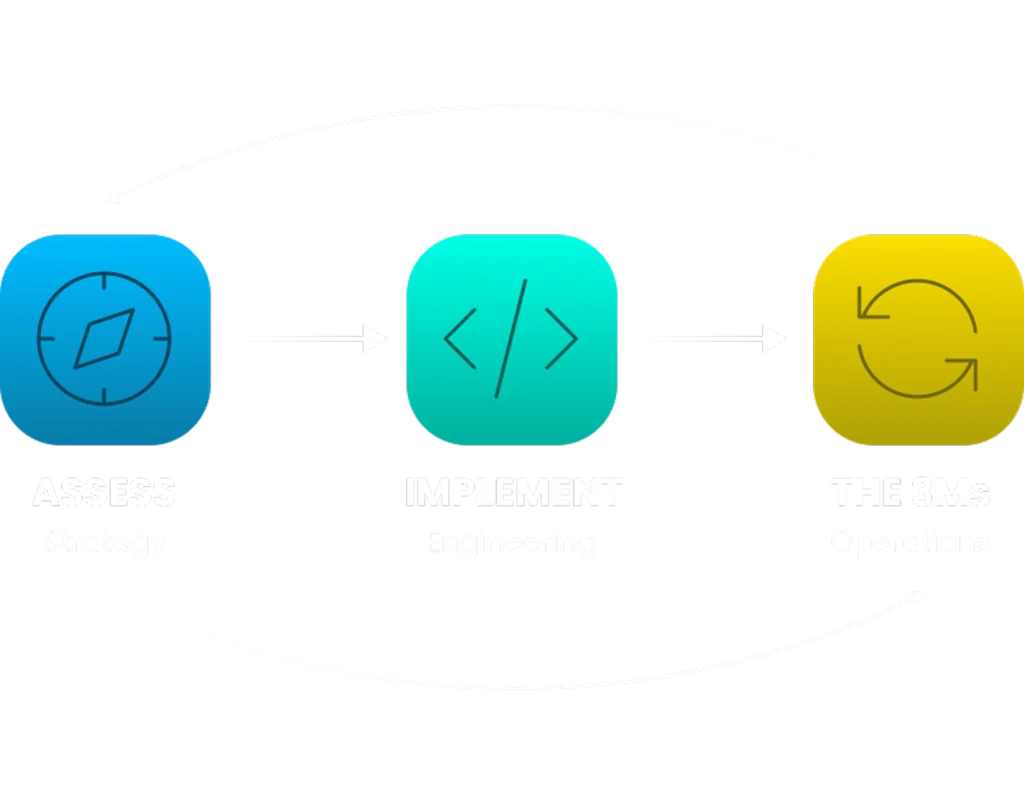
With deep domain understanding and first-hand experiences implementing successful AI initiatives, Gleecus TechLabs addresses this maturity gap with the AIM³ Framework- separating the Organizational AI lifecycle into three explicit engineering disciplines:
Assess:
Strategic validation and architectural clarity.
Implement:
Enterprise-grade AI engineering.
The 3Ms:
Continuous operations, reliability, and value realization.
How it works
Assess & Architecture
The Gatekeeper of Innovation
Before a single line of code is written, we establish truth. The Assess phase serves as a rigorous gatekeeper, designed to answer three fundamental questions:
Does this problem require AI intelligence?
Is the organization technically and operationally ready?
What is the minimum effective form of AI required to create value?
We reject the AI for AI’s sake approach. We systematically audit the proposed use case to ensure it solves a genuine business constraint.
Process Friction Analysis
We map existing workflows to identify high-friction points (manual data entry, bottlenecked decision-making) where AI can provide non-linear improvements.
Deterministic vs. Probabilistic Assessment
We rigorously challenge the need for GenAI. If the problem can be solved with deterministic software (Rule Engines, RPA, or Standard Analytics) with higher accuracy and lower cost, we recommend that path.
Value Metric Definition
We move beyond just efficiency to define hard metrics. Success metrics are defined upfront and tied directly to business outcomes.
AI systems inherit the weaknesses of the data they consume. We perform a forensic audit of your data estate to ensure viability.
Data Hygiene & Quality Audit
Completeness: Are key fields populated consistently?
Accuracy: Does the historical data reflect ground truth?
Consistency: Are data formats standardized across systems?
Integration Systems Availability
API Readiness: Do core systems (ERP, CRM, DataWarehouses, 3rd Party Systems) have accessible APIs for data retrieval?
Latency Checks: Can the infrastructure support real-time data fetching required for AI?
Silo Analysis: Is the required data locked in proprietary formats or legacy on-prem systems that require modernization first?
Governance & Lineage
PII/PHI Exposure: Identifying sensitive data fields that require masking.
Data Ownership: Establishing clear ownership of data sources to ensure long-term maintenance.
We design the target architecture based on the principle of Minimum Effective Intelligence.
Machine Learning (ML)
Selected for high-precision tasks like churn prediction, demand forecasting, and fraud classification.
Generative AI (GenAI)
Selected for cognitive tasks like document synthesis, semantic search, and natural language interfaces.
Agentic Systems
Selected for autonomous execution where multi-step reasoning and tool use are required.
KEY DELIVERABLE
The AI Readiness Report & Technical Blueprint
A formal Go/No-Go artifact outlining target architecture, TCO, risk profile, and phased execution roadmap.
Implementation is where strategy transforms into software. We engineer resilient, containerized production systems designed for longevity and scale, not just simple Python notebooks.
We execute the approved blueprint through structured agile sprints accelerated using AI led Software Engineering and QA, focusing on robust infrastructure.
Modern Data Stack Setup
Configuring the necessary data pipelines(structured, unstructured and semi-structured) to feed the AI models.
Vector Database Implementation
Setting up high-performance vector embedding stores for efficient context retrieval.
Deep Ecosystem Integration
Embedding AI capabilities directly into user workflows and existing systems(where applicable) to minimize friction.
For advanced use cases, we move beyond textual generation to autonomous action.
Multi-Agent Architecture
Configuring the necessary data pipelines(structured, unstructured and semi-structured) to feed the AI models.
Tool Use Configuration
Enabling agents to securely interact with external APIs, run actions, or trigger webhooks.
Reasoning Frameworks
Implementing Chain-of-Thought (CoT) or ReAct reasoning and action strategies to improve decision logic.
Enterprise software must be predictable. We wrap probabilistic models in deterministic safety layers.
Hallucination Firewalls
Implementing logic gates that verify AI outputs against ground-truth data before showing them to the user.
Role-Based Access Control (RBAC)
Ensuring the AI respects the existing permission structures of your organization (e.g., a junior employee cannot query CEO-level payroll data).
PII Redaction
Automated masking of sensitive information in prompt payloads to ensure compliance (GDPR/SOC2).
KEY DELIVERABLE
Production-Grade AI System or MVP
Fully deployed, integrated, and secured within the client's operating environment.
Implementation is the starting line, not the finish. The M³ loop represent the operational loop that keeps AI systems accurate, trustworthy, and economically viable over the long term.
MONITOR
System Health & Reliability
Drift Detection
Data and concept drift detection
Quality Telemetry
Hallucination, faithfulness, and relevance scoring
Operational Health
Latency, uptime, API error rate, and cost monitoring
MEASURE
Proof of Business Value
Financial ROI
Financial ROI and cost-benefit tracking
Operational Impact
Token-level cost visibility
User Adoption
Efficiency gains, cycle time reduction, and adoption metrics
MATURE
From Capability to Platform
Feedback Loops
Continuous feedback loops (RLHF)
FinOps
FinOps optimization and model routing
Governance
AI governance and Center of Excellence (CoE) setup
Stop Guessing. Start Engineering.
The difference between an AI experiment and an enterprise capability is discipline.
Free Resources
Free AIM³ Blueprints
Industry-specific frameworks to jumpstart your AI journey.
Life Sciences
The CIO’s Guide to Engineering AI for Regulated Innovation
Healthcare
The CIO’s Guide to Engineering Clinically Safe AI Systems
Insurance
The CIO’s Guide to Engineering Trustworthy AI for Risk & Claims
Manufacturing
The CIO’s Guide to Engineering AI for Industrial Excellence
Banking
The CIO’s Guide to Engineering Secure, Auditable AI Systems