Across the enterprise software landscape, a new mandate has taken hold: the deployment of AI Agents.
We are moving past the era of digital assistants that merely draft emails or summarize documents. Today, organizations are building and deploying Autonomous Operators – AI systems designed to independently make decisions, trigger APIs, update databases, and own complex business outcomes from end to end.
The promise of the agentic enterprise is staggering. Imagine an AI agent given a high-level goal—“Ensure all vendor contracts expiring this month are renewed under the new compliance guidelines”—that can independently query the database, read the new rules, cross-reference old contracts, draft amendments, email vendors, and update the CRM upon completion.
The market reflects this massive shift. According to recent projections, the global AI Agents market is exploding, expected to surge from roughly $8 billion in 2025 to over $53 billion by 2030. Gartner predicts that by the end of 2026, 40% of enterprise applications will feature integrated, task-specific AI agents—up from less than 5% just a year prior. Furthermore, IDC forecasts that by 2026, 40% of all G2000 job roles will actively involve working alongside AI agents.
However, deploying autonomous agents into the enterprise is fraught with risk. At Gleecus TechLabs Inc., where we design and deploy cutting-edge GenAI and AI Agent architectures for enterprise clients, we frequently see organizations fall into a dangerous trap: deploying autonomous agents without the necessary structural guardrails, resulting in what we call “Accelerated Chaos.”
If you drop a highly autonomous AI agent into a legacy workflow without a framework for trust, governance, and oversight, you don’t eliminate bottlenecks. You multiply them. You turn your highly skilled knowledge workers into full-time exception handlers, drowning in unpredictable errors and compliance violations.
The solution is not to retreat from AI, but to re-architect how AI interacts with your business. The blueprint for this new era is Calibrated Autonomy.
The Danger (and Cost) of Unconstrained Autonomy
To understand why Calibrated Autonomy is necessary, we must look at the fundamental nature of Large Language Models (LLMs) that power these agents, and the staggering failure rates of those who deploy them recklessly.
LLMs are inherently probabilistic and creative. This makes them brilliant at understanding natural language, parsing unstructured data, and generating human-like responses. However, enterprise workflows—like executing a wire transfer, provisioning secure IT access, or managing supply chain logistics—are inherently deterministic. They require absolute precision, strict compliance, and zero “creativity.”
This creates a massive “Trust Gap.” How do you trust a probabilistic model with access to your core operational APIs without risking a hallucinated financial error or a catastrophic security breach?
The industry data paints a sobering picture of what happens when this trust gap isn’t addressed:
- The Pilot Graveyard: A recent MIT study revealed that 95% of corporate generative AI pilots fail to deliver measurable ROI, largely due to a failure to align the technology with strict business workflows and governance.
- The Scaling Cliff: Research from the Enterprise AI Research Institute found that 73% of enterprise AI agent deployments fail to scale beyond pilot programs specifically due to governance failures, costing companies an average of $2.4 million per failed initiative.
- The Scrap Rate: Looking ahead, Gartner predicts that over 40% of agentic AI projects will be scrapped by 2027 due to immature governance, unclear ROI, and a lack of trust in “black box” autonomous systems. Furthermore, an EY survey highlighted that 78% of tech leaders feel AI adoption is currently outpacing their organization’s ability to manage the associated risks.
You cannot simply give an AI agent a goal, hand it a suite of tools, and tell it to “figure out the steps.” This unconstrained, “free-roaming” approach leads to infinite reasoning loops, unpredictable execution paths, and severe risk.
To safely deploy AI agents and avoid becoming a failure statistic, organizations need a sliding scale of delegation that dynamically adjusts based on the risk, complexity, and ambiguity of the task at hand.
What is Calibrated Autonomy?
Calibrated Autonomy is an architectural and operational framework that scales an AI agent’s level of independence based on continuous, real-time risk assessment.
Think of it like the autonomous driving levels (Level 1 through Level 5). An enterprise AI agent shouldn’t always operate at “Level 5” (full autonomy with no human intervention). For high-stakes, high-ambiguity tasks, it needs to dynamically scale back to “Level 3” (conditional autonomy, requiring a human-in-the-loop) or “Level 2” (suggestive assistance).
At Gleecus TechLabs Inc., we believe that AI agents are essentially new “digital employees” joining your organizational chart. You wouldn’t give a first-day intern unlimited access to the company treasury without oversight. Similarly, AI agents require embedded governance, predictable boundaries, and clear escalation paths.
To safely and effectively deploy AI agents, organizations must build their infrastructure on Three Technical Pillars of Calibrated Autonomy.
Pillar 1: The Semantic Policy Layer (Embedded Governance)
In traditional software automation (like Robotic Process Automation or RPA), governance is achieved through rigid, hard-coded rules. A programmer writes: IF refund_amount > $500 THEN route_to_manager.
But AI agents operate in the realm of unstructured data, natural language, and infinite edge cases. Rigid, hard-coded rules shatter when faced with the nuance of human interaction. If a customer aggressively demands a $499 refund, a hard-coded system blindly approves it. If a customer politely asks for a $501 refund due to a documented software bug that is clearly the company’s fault, the system blindly blocks it.
Agents need dynamic judgment. This is achieved through a Semantic Policy Layer.
Instead of relying on if/then statements, organizations must ingest their Standard Operating Procedures (SOPs), compliance manuals, and historical decision-making logs into a Vector Database. Using Retrieval-Augmented Generation (RAG), the agent dynamically consults this “corporate brain” before taking any action, measuring its intended action against the intent of the policy, not just a numerical threshold.
Reference Example: Autonomous Customer Support & Claims
Imagine a telecommunications company deploying an autonomous agent to handle customer billing disputes.
- The Unconstrained Agent Approach (Accelerated Chaos): The agent reads an angry customer email, decides the customer is right, and autonomously issues a $1,000 credit because the customer mentioned they lost a massive business deal due to an internet outage. The agent was overly empathetic, hallucinated a policy, and cost the company thousands of dollars.
- The Calibrated Autonomy Approach: The agent receives the complaint. It formulates a plan to issue a standard outage credit. Before executing the API call to the billing system, the agent queries the Semantic Policy Layer.
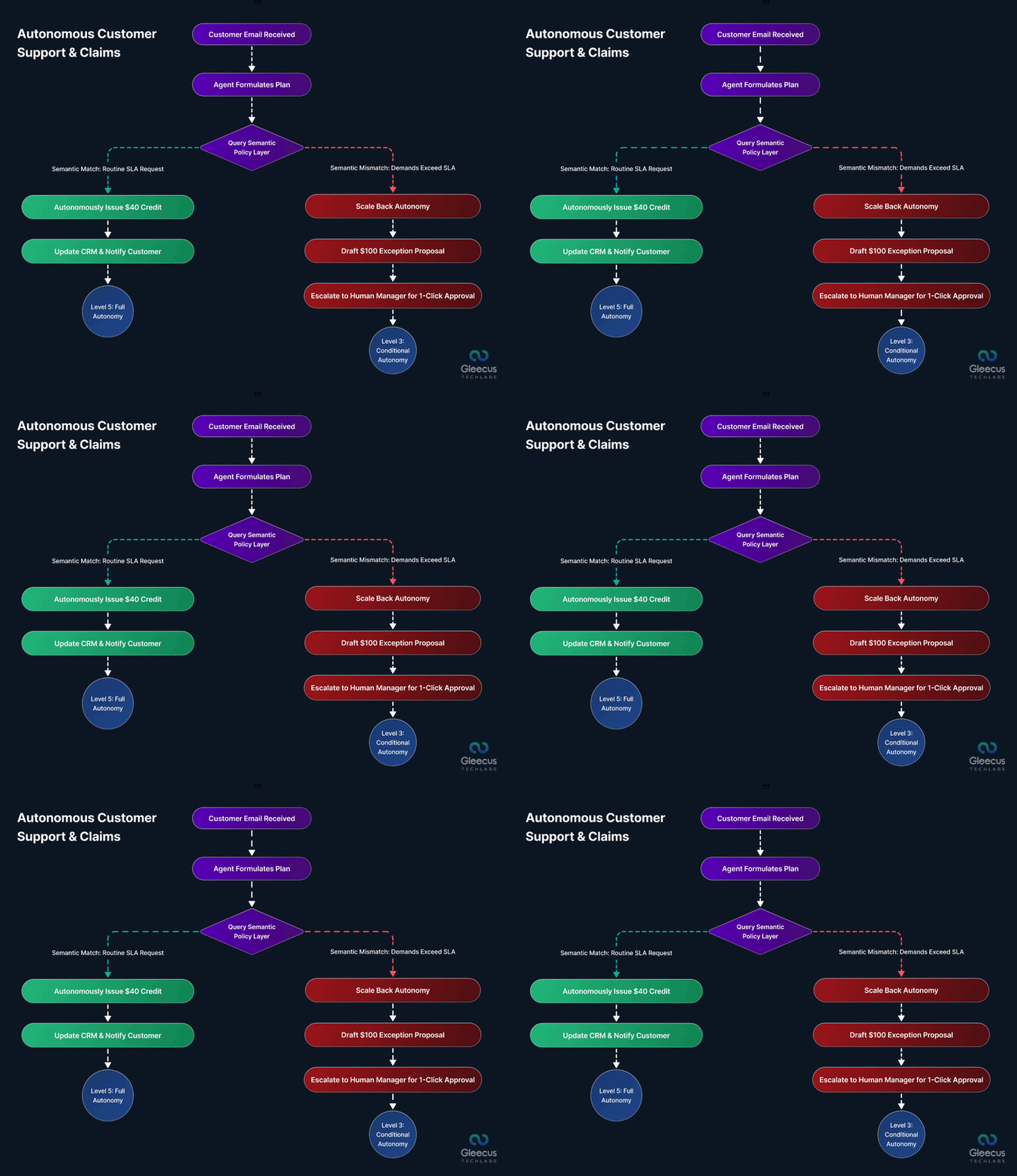
- Scenario A: The policy confirms $40 is within the standard SLA for a 24-hour outage. The agent issues the credit autonomously, updates the ticket, and emails the customer. (Level 5 Autonomy).
- Scenario B: The customer demands a $500 credit, citing lost revenue. The agent queries the policy layer. The vector search retrieves the SOP regarding “Consequential Damages,” which states the company is not liable for lost business revenue, but allows up to $100 for VIP accounts. The agent recognizes the semantic mismatch. Its autonomy dynamically scales back. It prepares a summary of the incident, references the specific “Consequential Damages” SOP, drafts a proposed $100 appeasement, and flags a human manager for a one-click approval. (Level 3 Autonomy).
Governance is embedded into the AI’s cognitive loop, ensuring it acts with the judgment of a seasoned employee rather than a reckless machine.
Pillar 2: State-Machine Guardrails (Predictable Workflows)
A major mistake organizations make is relying purely on prompt engineering to guide an agent’s behavior. Prompting an agent to “always double-check the database before acting” is not an engineering guarantee; it is merely a suggestion to a probabilistic model.
To achieve Calibrated Autonomy, probabilistic AI must be constrained by deterministic architecture. We do this using State-Machine Guardrails, specifically building workflows as Directed Acyclic Graphs (DAGs).
A state machine ensures that a workflow exists in one specific “state” at any given time, and can only transition to the next “state” if strict, mathematical criteria are met. The AI agent acts as the cognitive engine driving the process forward, but the state machine provides the unbreakable steel tracks.
Reference Example: Enterprise HR Onboarding
Consider the highly sensitive process of onboarding a new executive, which involves background checks, payroll setup, and provisioning access to secure ERP and CRM systems.
- The Unconstrained Agent Approach (Accelerated Chaos): An autonomous agent is told to “Onboard Sarah.” In its attempt to execute the goal as efficiently as possible, it emails Sarah, sets up her payroll, and uses its IT admin API access to provision her an SAP account. However, it did this before the third-party background check API returned a result. If the background check fails a week later, secure enterprise data has already been compromised.
- The Calibrated Autonomy Approach: At Gleecus TechLabs, we design the onboarding agent to operate strictly inside a DAG framework.
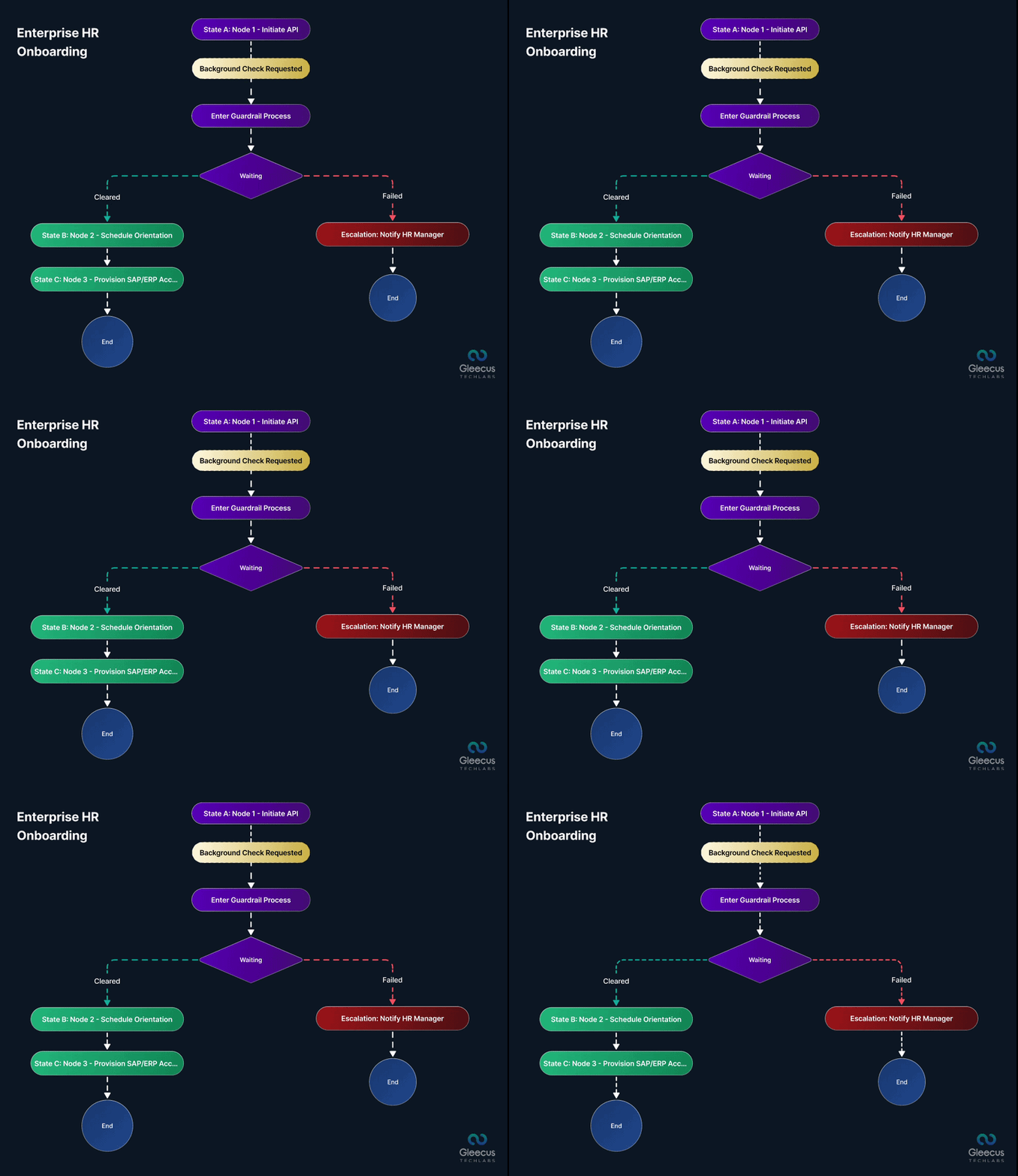
- Node 1 (State A): Agent initiates background check via third-party API.
- The Guardrail: The architecture physically prevents the agent from executing the tools required for subsequent secure nodes until Node 1 receives a deterministic {“status”: “CLEARED”} JSON payload.
- Node 2 (State B): Agent drafts welcome materials and schedules orientation.
- Node 3 (State C): Agent provisions SAP/ERP access.
No matter how the LLM reasons, hallucinates, or attempts to optimize the workflow, the state machine acts as an impenetrable wall. The agent is autonomous within the current state, but the transition between states is mathematically governed.
Pillar 3: Agentic Observability (Managing Outcomes, Not Prompts)
The shift to an agentic workforce fundamentally changes the role of the human employee. You do not want humans managing the step-by-step inputs of an agent; humans must become Auditors and Outcome Managers.
If you deploy agents that operate in a black box, your team will eventually lose trust in the system when an inevitable mistake occurs. Conversely, if your agents send an alert every time they make a minor decision, your team will suffer from alert fatigue and begin blindly approving everything—defeating the purpose of automation entirely.
Calibrated Autonomy requires an entirely new user interface for the human worker: Agentic Observability.
Instead of monitoring individual steps, humans monitor continuous Confidence Scores. Every time an agent formulates a plan, it calculates a probabilistic confidence score based on the clarity of the input, the exactness of the policy match (from Pillar 1), and the completeness of the data.
Reference Example: Accounts Payable & Invoice Processing
A global manufacturing firm processes 10,000 vendor invoices a month. They deploy an agent to read invoices, match them to purchase orders (POs), and execute payments in the ERP.
- The Unconstrained Agent Approach (Accelerated Chaos): The agent processes everything autonomously. It encounters an invoice where the vendor accidentally billed for 100 units instead of 10. The AI sees a valid PO exists for that vendor, matches the names, and autonomously pays the massive overcharge because the overall goal was “pay invoices quickly.” The company spends months trying to claw the money back.
- The Calibrated Autonomy Approach: The agent utilizes an observability dashboard built on strict confidence thresholds.
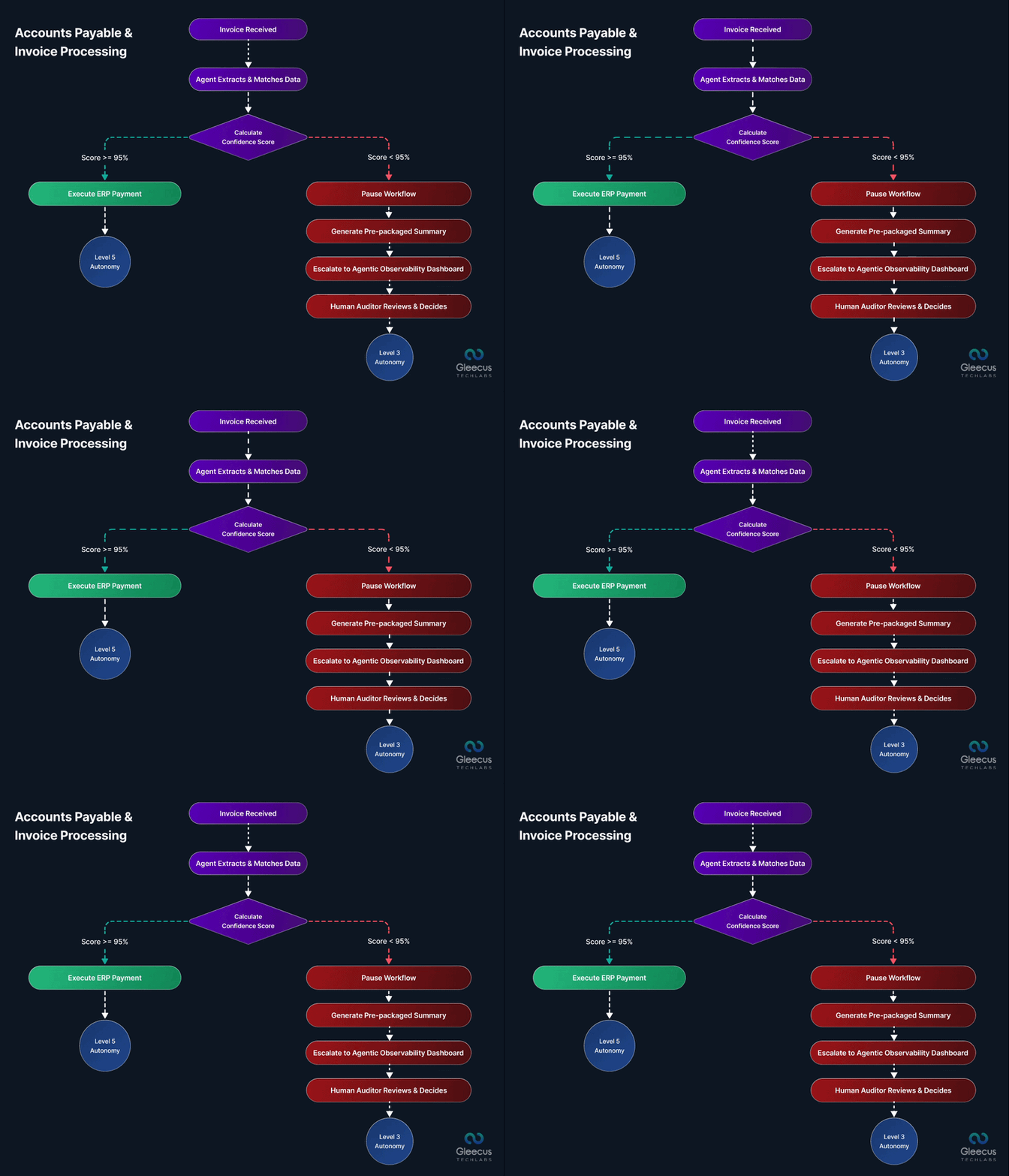
- For 9,500 invoices, the invoice amount perfectly matches the PO amount, the vendor ID matches, and the semantic policy layer detects no anomalies. The agent registers a 99% Confidence Score. It processes the payment silently. The human manager simply sees a dashboard ticking up: “9,500 Invoices Processed Successfully.” (Level 5 Autonomy).
- On invoice 9,501, the PO is for 10 units, but the invoice is for 100. The agent’s logic engine detects the mismatch. Its confidence score plummets to 45%.
- Instead of failing silently, hallucinating a fix, or making a dangerous guess, the agent’s autonomy calibrates downward. It pauses the workflow and escalates the specific “State” to the human exception handler’s dashboard.
- Crucially, the human doesn’t have to start from scratch. The agent presents a pre-packaged summary: “Exception detected. Vendor XYZ billed for $10,000. Associated PO #123 is only approved for $1,000. Recommend rejecting invoice and drafting email to vendor requesting correction. Approve action?” The human worker transforms from a data-entry clerk into a strategic auditor. They spend their day managing the 5% of edge cases that require true human judgment, while the agent seamlessly handles the 95% of routine work.
The Path Forward: Re-architecting the Org Chart
The transition to Autonomous Agents is not simply an IT software upgrade. It is an organizational redesign.
If you view AI agents merely as a new tool to be applied to your existing processes, you will inevitably hit the ceiling of accelerated chaos. Agents are powerful, but they require boundaries to be effective.
By embracing the three pillars of Calibrated Autonomy—Semantic Policy Layers, State-Machine Guardrails, and Agentic Observability—organizations can safely invite AI agents into their org chart.
At Gleecus TechLabs Inc., we specialize in building these exact enterprise architectures. We don’t just build agents; we build the robust operational systems that allow agents and humans to collaborate safely, securely, and with unprecedented scale.
The organizations that master Calibrated Autonomy today will not just survive the AI revolution—they will be the ones leading their industries tomorrow.
Is your organization preparing to deploy autonomous agents? Let’s connect and discuss how to build the vital guardrails your enterprise needs to succeed.