The conversation around artificial intelligence has moved quickly from chatbots and generative models to systems that can plan, act, and coordinate. Two terms dominate this discussion: AI Agents and Agentic AI. They are related, but they are not the same. Understanding the difference is essential for any organization planning its next phase of intelligent automation.
At Gleecus TechLabs Inc., we work with enterprises that are navigating this shift from task-level automation toward more autonomous, goal-driven systems. Leaders often hear both terms used interchangeably, which creates confusion in architecture reviews, vendor evaluations, and budget discussions. This article clarifies what AI Agents and Agentic AI actually mean, how they differ, where each fits, and how industries are applying them today. The goal is practical clarity: so teams can choose the right level of capability without over-engineering or under-delivering.
Understanding AI Agent and Agentic AI
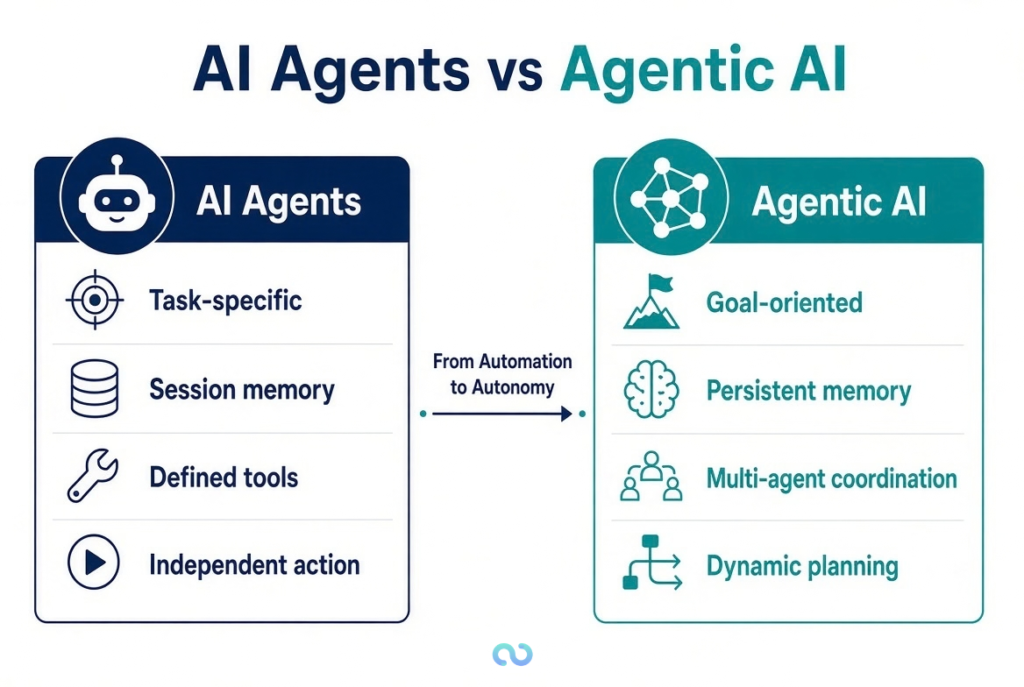
An AI Agent is a software component. It perceives inputs, reasons over them, uses tools, and acts toward a defined goal, usually within a bounded scope. Agentic AI, by contrast, describes a broader system property or architecture: the capacity for sustained, goal-directed autonomy, often involving planning, multi-step coordination, persistent memory, and collaboration among multiple agents.
In short:
- An AI Agent is something you deploy.
- Agentic AI is a quality of how a system plans, decides, and acts.
This distinction shapes architecture decisions, governance models, and the level of autonomy an organization is prepared to support. When teams treat every capable assistant as fully agentic, they often introduce unnecessary orchestration complexity. When they treat every multi-step process as a single agent problem, they hit limits in memory, coordination, and reliability. Getting the language right is the first step toward getting the design right.
What Are AI Agents?
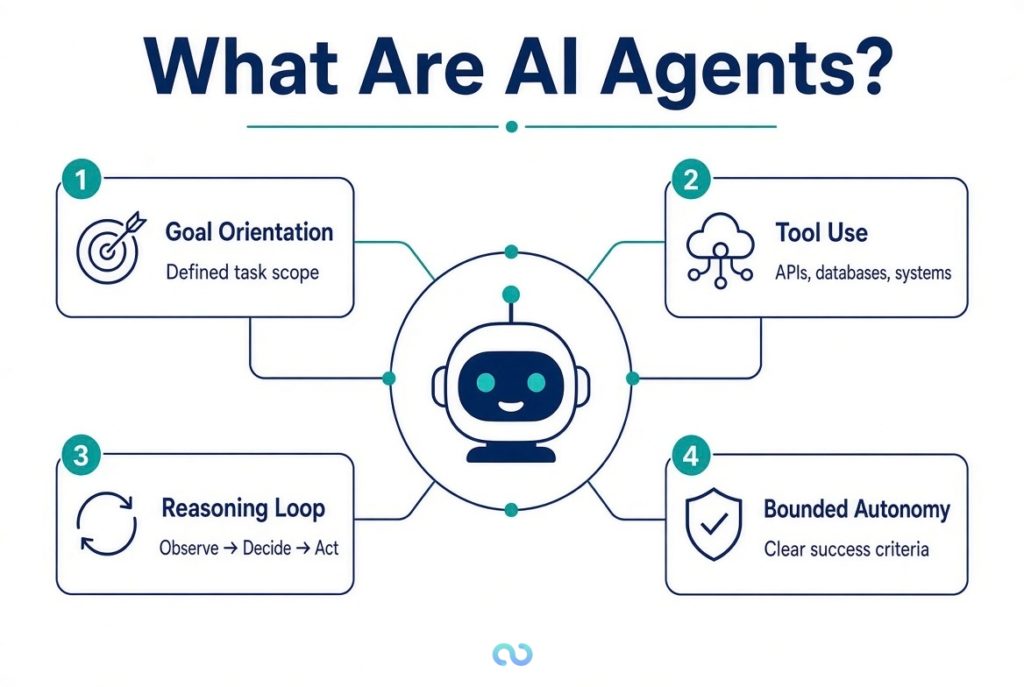
AI Agents are modular systems, typically powered by large language models, that combine reasoning with tool use. They can interpret instructions, call APIs, retrieve information, and complete specific tasks with limited ongoing supervision. Unlike pure generative systems that only produce text or media, AI Agents close the loop between understanding and action.
Common characteristics of AI Agents include:
- Goal orientation within a defined scope
- Tool integration (APIs, databases, knowledge bases, enterprise systems)
- Session-level or limited persistent context
- Reactive or lightly proactive behavior
- Clear success criteria for a single task or workflow
In practice, an AI Agent might classify and route a support ticket, draft a response grounded in a knowledge base, schedule a meeting based on calendar constraints, extract structured data from documents, or trigger a well-defined operational step in a CRM or ERP. These systems represent a meaningful advance over pure generative AI because they do not only produce content. They take action within controlled boundaries.
The value of AI Agents shows up most clearly when the task is repeatable, the tools are known, and success can be measured cleanly. They reduce manual effort, improve consistency, and create a foundation for more advanced autonomy later. Many organizations begin their agent journey here: one high-volume workflow, one clear owner, and one measurable outcome.
What Is Agentic AI?
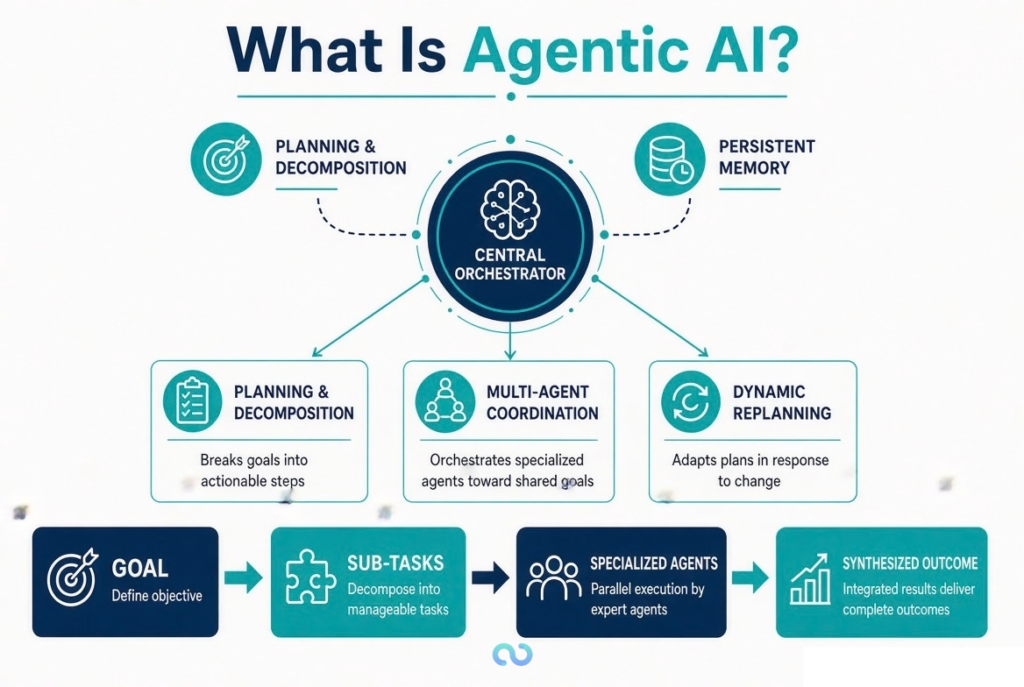
Agentic AI refers to systems designed for higher degrees of autonomy and coordination. Rather than completing one discrete task, these systems pursue broader goals. They decompose objectives into sub-tasks, adapt plans based on intermediate results, maintain memory across steps or sessions, and often coordinate multiple specialized agents.
Key traits of Agentic AI systems include:
- Multi-step planning and dynamic replanning
- Persistent or cross-session memory
- Coordination across specialized agents or tools
- Greater initiative in monitoring and acting
- Focus on outcomes rather than single-task completion
Where a single AI Agent might resolve one support inquiry, an agentic system might manage the full resolution path. It gathers context from multiple systems, selects the right tools, escalates when policy requires it, updates records, notifies stakeholders, and learns from the outcome for future similar cases. The system is oriented toward the result, not just the next micro step.
This does not mean Agentic AI is always preferable. Higher autonomy increases the surface area for failure modes such as coordination errors, unexpected emergent behavior, and harder to trace decision paths. The benefit appears when the business process itself is complex, variable, and cross functional, exactly the conditions where rigid scripts and single purpose agents fall short.
AI Agents vs Agentic AI: Key Differences
| Dimension | AI Agents | Agentic AI |
|---|---|---|
| Nature | A software component or unit | An architectural capability or system property |
| Scope | Specific task or bounded workflow | Multi-step, cross-system, or outcome-oriented goals |
| Planning | Limited or task-level | Dynamic goal decomposition and adaptation |
| Memory | Often session-scoped | Persistent across workflows or sessions |
| Coordination | Operates independently or with light handoffs | Orchestrates multiple agents, tools, and systems |
| Autonomy | Autonomy within defined boundaries | Sustained, goal-directed autonomy |
| Main failure modes | Hallucination, brittleness | Coordination failure, emergent behavior |
| Governance focus | Permissions and evaluation of the individual agent | Isolation, observability, and control across the system |
The practical implication is clear: start with AI Agents when the work is well-scoped. Move toward Agentic AI when the work requires decomposition, persistent context, or multi-worker coordination.
Teams evaluating vendors or internal builds should ask two separate questions. First: What component are we deploying (the agent)? Second: How agentic does the overall system need to be (planning depth, memory, coordination, initiative)? Conflating those questions leads to either underpowered solutions or unnecessarily complex ones.
The Shift from Automation to Autonomy
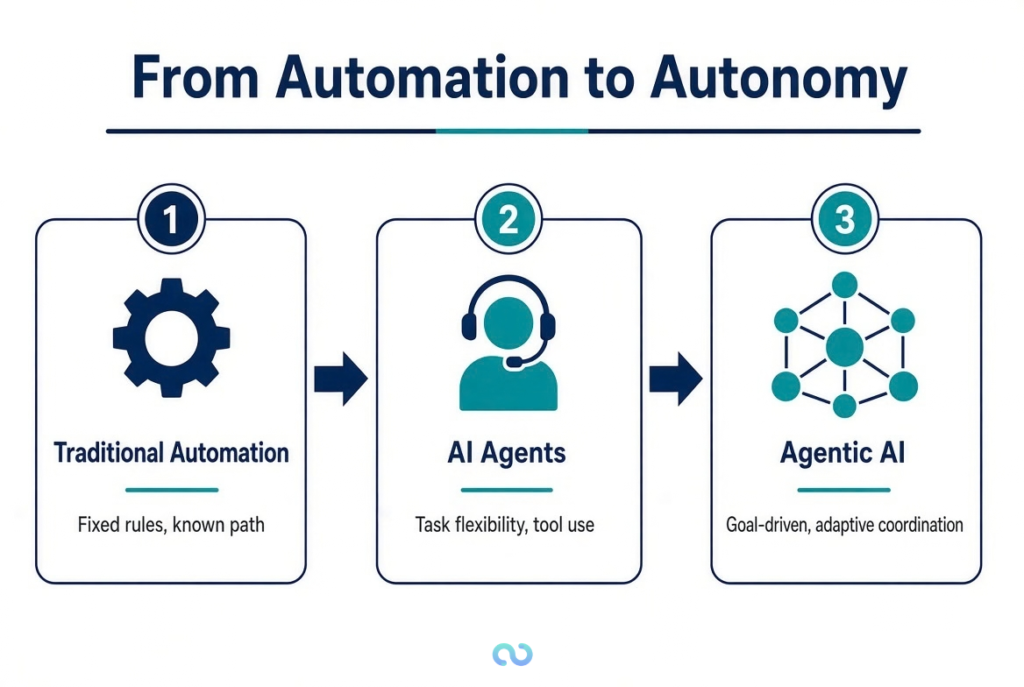
Traditional automation follows fixed rules. If condition A occurs, execute step B. It is reliable for high-volume, stable processes, but brittle when conditions change or inputs are messy. Rule engines and robotic process automation excel when the path is known and exceptions are rare.
AI Agents introduce flexibility. They interpret unstructured inputs, select tools, and complete tasks that would be difficult to hard-code. They still operate largely within predefined boundaries: the organization defines the goal shape, the toolset, and the success criteria.
Agentic AI pushes further. It treats the goal as primary and the path as negotiable. The system can replan, call different tools, hand work between specialized agents, and adjust when intermediate results change the picture. This is the shift from automation to autonomy: from executing known steps to pursuing outcomes under uncertainty.
That shift brings new requirements: stronger observability, clearer escalation paths, and governance that matches the level of autonomy granted. Organizations that skip these controls often experience early demos that impress and production deployments that disappoint. Autonomy without visibility is not progress; it is risk transferred to operations.
Architecture and Capabilities Compared
At a high level, a typical AI Agent includes:
- A reasoning component (often an LLM)
- Access to a defined set of tools
- Short-term or session memory
- A loop of observe → decide → act within a single task
An Agentic AI architecture typically adds:
- An orchestration or planning layer
- Multiple specialized agents with distinct roles
- Shared or persistent memory
- Mechanisms for handoff, escalation, and synthesis
- Evaluation and policy controls across the workflow
In agentic designs, specialized agents might own distinct responsibilities such as retrieval, analysis, drafting, compliance checking, or system updates, while an orchestrator maintains the overall plan and decides what happens next. This separation improves modularity and allows teams to strengthen individual capabilities without rewriting the entire system. It also creates clearer places to attach monitoring, budgets, and human approval gates.
Industry Applications
Different industries experience the shift from AI Agents to Agentic AI in different ways. The common pattern is the same: begin where tasks are frequent and measurable, then expand toward coordinated outcomes where complexity justifies the architecture.
Healthcare
In healthcare, AI Agents support focused tasks such as appointment scheduling support, clinical documentation assistance, retrieval of guidelines, or triage of administrative requests. These uses reduce friction for staff and patients while remaining within clear operational boundaries.
Agentic AI becomes relevant for multi-step processes such as care coordination across departments, prior authorization workflows, longitudinal patient engagement, or exception handling that spans clinical and administrative systems. Here, planning, handoffs, and persistent context matter more than any single micro-task.
Governance, privacy, and clinical oversight are non-negotiable. Autonomy must be matched with auditability and clear escalation to human professionals.
Life Sciences
AI Agents in Life Sciences accelerate literature review, data extraction from studies, protocol drafting support, and structured summarization of research materials. These applications compress time on labor-intensive information work.
Agentic AI supports broader research and development workflows such as hypothesis generation pipelines, multi-source synthesis, trial design support, and coordinated analysis sequences, where multiple specialized capabilities must work together over longer horizons. Persistent memory and adaptive planning help teams move from isolated insights to connected research processes.

Retail
Retail benefits from AI Agents in product discovery assistance, cart recovery messaging, order status responses, and post-purchase support. These agents improve conversion and service efficiency when scoped tightly to high-volume moments.
Agentic AI enables end-to-end journey orchestration, connecting discovery, personalization, inventory-aware recommendations, fulfillment decisions, and loyalty engagement into a coordinated experience rather than isolated interactions. The customer feels continuity; the systems behind the scenes manage dependencies and context.
Manufacturing
AI Agents in Manaufacturing assist with anomaly alerts, work-order drafting, knowledge retrieval for technicians, and structured reporting from operational data. They reduce response time on known patterns.
Agentic AI supports predictive maintenance coordination, production exception handling, and multi-system operational workflows that require planning across sensors, maintenance systems, inventory, and scheduling. When a potential failure is detected, an agentic approach can gather evidence, check parts availability, propose a maintenance window, and prepare the next actions under defined human approval where needed.
Banking and Financial Services
AI Agents in Banking and Financial Services handle document classification, customer inquiry routing, routine compliance checks, and standard operational requests. They improve throughput on repetitive work with clear rules and audit needs.
Agentic AI addresses complex processes such as multi-step onboarding, exception handling in payments, coordinated risk and operations workflows, or case management that spans systems and decision points. Financial services demand strong controls: least privilege, explainability, and human oversight for material decisions remain essential even as autonomy increases.
When to Use AI Agents vs Agentic AI
Choose AI Agents when:
- The task is well-defined and success is easy to measure
- Inputs and tools are relatively stable
- You need fast deployment and clear accountability
- Isolation and simplicity reduce risk
- A single owner can evaluate quality end to end
Move toward Agentic AI when:
- Goals require multiple steps with dependencies
- Context must persist across interactions or systems
- Specialized capabilities need to collaborate
- The process benefits from dynamic replanning
- Business value comes from outcomes, not just task completion
A practical rule many teams follow: start with a single, well-scoped AI Agent. Promote to agentic orchestration only when evaluation shows genuine need for task decomposition, persistent memory, or multi-agent coordination.
This staged approach reduces wasted investment. It also creates organizational learning. Teams develop skills in evaluation, monitoring, and governance before complexity multiplies.
Design and Governance Considerations
Higher autonomy raises the stakes for design and oversight. Whether you deploy individual AI Agents or build toward Agentic AI, the following principles help keep systems reliable and accountable:
- Least agency: Grant only the autonomy required for the use case. Prefer constrained powers over open-ended capability.
- Clear boundaries: Define what agents may decide versus what must be escalated to a human.
- Observability: Capture plans, tool calls, handoffs, intermediate results, and final outcomes in a way operators can inspect.
- Isolation: Limit the blast radius of any single agent’s actions through scoped credentials and controlled tool access.
- Human oversight: Maintain human-in-the-loop or human-on-the-loop controls for high-impact or irreversible decisions.
- Evaluation: Continuously measure accuracy, reliability, latency, cost, and business outcomes, not only demo quality outputs.
- Policy alignment: Encode regulatory, security, and brand constraints into runtime checks, not only into prompts.
These practices apply to both AI Agents and Agentic AI, but become more critical as coordination complexity grows. Agentic systems introduce additional failure modes such as routing mistakes, conflicting agent outputs, and state inconsistencies that single agents do not face in the same way. Design for those realities early.
Frequently Asked Questions About AI Agents and Agentic AI
Are AI Agents and Agentic AI the same thing?
Not exactly. AI Agents are software systems capable of perceiving information, reasoning, using tools, and taking actions. Agentic AI describes a broader approach to goal-driven, adaptive, and autonomous behavior. The concepts overlap, and an AI Agent can be part of a larger Agentic AI system.
What is the difference between AI Agents and traditional automation?
Traditional automation generally follows predefined rules and workflows. AI Agents can interpret context, reason about tasks, use tools, and select actions dynamically within their defined permissions.
Is Agentic AI the same as Generative AI?
No. Generative AI primarily creates or transforms content. Agentic AI uses AI models as part of systems designed to pursue goals, plan actions, interact with tools, and execute workflows.
Do Agentic AI systems always need multiple AI Agents?
No. A single AI Agent can demonstrate agentic behavior. Multi-agent architecture becomes useful when separate responsibilities, permissions, models, or capabilities need to be coordinated.
Where can AI Agents be used?
AI Agents can support customer service, finance, healthcare administration, software development, supply chain operations, manufacturing, retail, knowledge management, compliance, document processing, and many other workflows.
What are the biggest risks of Agentic AI?
Key risks include excessive permissions, unsafe tool use, goal manipulation, data leakage, memory poisoning, insecure communication between agents, cascading failures, inadequate human oversight, and insufficient monitoring.
How do enterprises control AI Agents?
Enterprises can use identity management, least-privilege access, tool-level authorization, policy enforcement, approval gates, audit logs, observability, testing, evaluation, runtime monitoring, and clear escalation procedures.
When should a business start with an AI Agent rather than a full Agentic AI system?
Start with an AI Agent when the business problem is well defined and the workflow has a manageable scope. A broader Agentic AI architecture becomes more relevant when the process spans systems, requires planning, contains dynamic conditions, and needs coordinated execution.
What role do AI Copilots play in the transition?
AI Copilots can act as an intermediate step between conventional automation and autonomous execution. They allow employees to work with AI for research, recommendations, analysis, content generation, and selected workflow actions while maintaining greater human involvement.
Looking Ahead
The shift from automation to autonomy is not a single leap. It is a progression. AI Agents deliver value today in well scoped workflows. Agentic AI unlocks broader outcomes when coordination, memory, and adaptive planning are genuinely required.
Organizations that understand the difference will make better architecture choices, set clearer governance expectations, and invest in the right level of capability at the right time. Those that treat every system as fully agentic risk complexity without benefit. Those that remain only at task-level automation may miss opportunities for deeper operational impact.
The path forward is deliberate. Clarify the goal, match the architecture to the problem, and build the controls that make autonomy safe and useful. As tools mature and evaluation practices improve, more processes will become candidates for agentic design, but the discipline of starting simple and scaling with evidence will remain a competitive advantage.