Every day, healthcare organizations generate vast amounts of clinical documentation—progress notes, discharge summaries, operative reports, and diagnostic findings. Turning that information into accurate medical codes and clean claims is essential for timely reimbursement and healthy cash flow. Yet traditional medical coding and claims processing remain slow, repetitive, and vulnerable to costly errors.
This is where AI Agents are beginning to make a meaningful difference. By combining document understanding, rule-based reasoning, and coordinated workflow execution, these systems help healthcare teams move faster while improving consistency and reducing administrative burden.
The Everyday Reality of Medical Coding and Claims Processing
Medical coding is the process of translating clinical information into standardized codes such as ICD-10 and CPT. Claims processing then packages those codes with patient demographics, provider details, and supporting data, checks them against payer requirements, and submits them for payment.
When performed manually, these steps often involve:
- Reading lengthy and sometimes ambiguous clinical notes
- Applying complex coding guidelines that change regularly
- Interpreting payer-specific rules and medical necessity criteria
- Correcting errors after claims are denied or rejected
- Managing backlogs that delay revenue and increase staff workload
The consequences are familiar across the industry: delayed payments, higher denial rates, extended days in accounts receivable, and teams stretched thin by repetitive work. Even highly skilled coders and claims specialists spend significant time on tasks that could be streamlined.
What Makes AI Agents Different
AI Agents go beyond basic automation or simple rule engines. They can read unstructured clinical text, reason about the content, apply coding and compliance rules, interact with related systems, and execute multi-step processes with defined levels of autonomy.
In practical terms, an AI Agent supporting revenue cycle operations might:
- Extract diagnoses, procedures, and clinical concepts from notes
- Suggest or assign appropriate medical codes with supporting rationale
- Validate information against eligibility data and payer policies
- Assemble complete claims packages in required formats
- Flag exceptions or low-confidence cases for human review
- Draft supporting documentation or appeal language when needed
Rather than replacing human expertise, well-designed AI Agents handle high-volume, repetitive work so coding and claims professionals can focus on complex, nuanced, or high-risk cases.
How AI Agents Accelerate Medical Coding
Coding is frequently the bottleneck in the revenue cycle. Clinical documentation is detailed, terminology is specialized, and guidelines continue to evolve. AI Agents help by systematically reviewing documentation, identifying relevant clinical elements, and mapping them to the correct codes.
Key capabilities include:
- Consistent extraction of diagnoses and procedures from unstructured text
- Mapping to ICD-10, CPT, and related code sets
- Early application of payer-specific and regulatory rules
- Identification of documentation gaps that could lead to denials
- Confidence scoring that helps prioritize human review
When coding agents work alongside clinical documentation improvement processes, organizations often see cleaner code assignments, fewer queries, and faster readiness for claim submission. The result is less rework and higher first-pass accuracy.
How AI Agents Streamline Claims Processing
Once codes are assigned, claims still require validation, assembly, compliance checks, and follow-up. AI Agents support these stages by coordinating information across systems and applying structured decision logic.
Typical contributions include:
- Checking patient eligibility and demographic consistency
- Detecting incomplete data, duplicates, or formatting issues
- Building claims packages according to required standards
- Identifying potential denial risks before submission
- Routing complex cases to specialists with relevant context
- Supporting appeals by gathering evidence and drafting responses
In multi-agent setups, different agents can specialize; one focused on documentation analysis, another on coding, another on claim assembly and validation—while operating under clear governance and human oversight. This coordinated approach reduces handoff delays and improves overall cycle time.
The Practical Benefits for Healthcare Organizations
Organizations that thoughtfully deploy AI Agents for medical coding and claims processing commonly experience several interrelated gains:
- Faster turnaround from clinical documentation to claim submission
- Higher first-pass acceptance rates through cleaner, more complete claims
- Fewer coding-related denials and reduced rework
- Improved staff capacity, as routine tasks shift to agents
- Stronger revenue cycle performance, including shorter days in accounts receivable
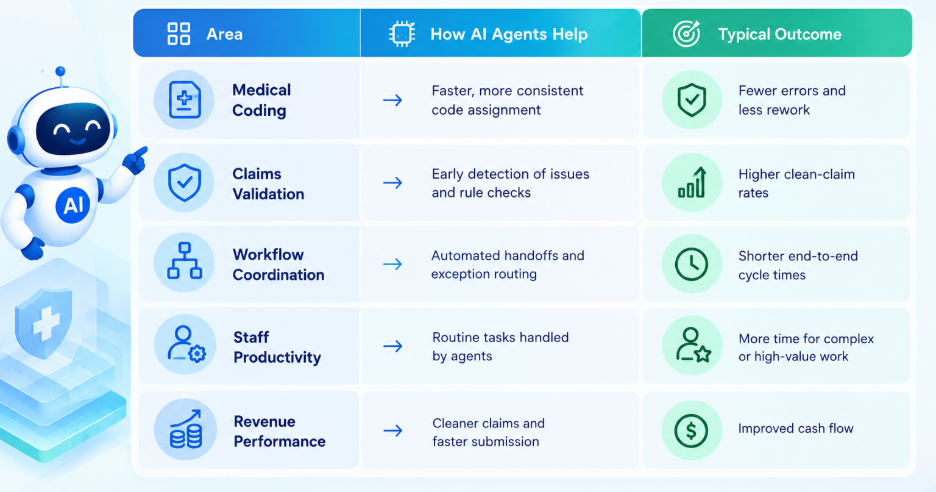
These benefits compound over time as systems learn from outcomes and teams refine how they collaborate with the agents.
Important Considerations for Successful Adoption
Technology alone is not enough. Sustainable results depend on several foundational elements:
- Reliable access to high-quality clinical and billing data
- Integration with existing electronic health records and revenue cycle platforms
- Clear policies defining when agents may act independently and when human review is required
- Ongoing monitoring for accuracy, compliance, and performance drift
- Training and change management so teams understand how to work effectively with the new tools
- Strong audit trails to support regulatory and operational accountability
Many organizations begin with focused use cases—such as high-volume service lines or areas with elevated denial rates—to demonstrate value quickly and build internal confidence before expanding.
Looking Ahead
AI Agents are transforming medical coding and claims processing from slow, manual bottlenecks into faster, more reliable, and more scalable workflows. By combining document understanding, domain-specific rule application, and coordinated action, they help healthcare organizations reduce administrative friction and strengthen financial performance.
The organizations that approach adoption thoughtfully, balancing automation with appropriate oversight, continuous evaluation, and team enablement—will be best positioned to gain lasting improvements in speed, accuracy, and operational resilience.