
As organizations move from isolated AI tools to coordinated multi-agent systems, a new architectural concept is gaining attention: the SuperAgent. These systems act as intelligent orchestration layers that coordinate specialized agents, tools, and workflows through a single point of interaction. Understanding what SuperAgents are and when they should be used, is essential for building scalable and governed AI architectures.
At Gleecus TechLabs Inc., we help organizations design robust agentic systems. This article explains SuperAgents, how they differ from specialized agents, and the conditions under which they add the most value.
What Are SuperAgents?
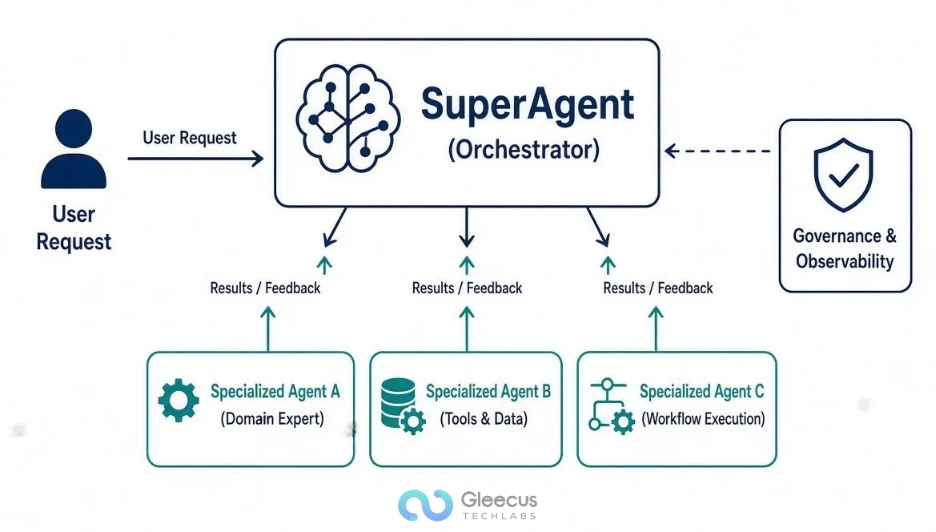
A SuperAgent is a central orchestration agent that serves as the primary interface for users or systems. Instead of handling every task itself, it interprets high-level goals, decomposes them into sub-tasks, and delegates work to specialized agents. It then synthesizes results and returns a coherent outcome.
In practical terms, a SuperAgent functions like a general contractor: it understands the overall objective, assigns work to domain experts (specialized agents), monitors progress, and ensures the final result meets the original intent.
Key characteristics of SuperAgents include:
- Central coordination and planning
- Ability to route tasks across multiple specialized agents
- Maintenance of conversation or workflow context
- Synthesis of outputs from different sources
- Single point of interaction for users or upstream systems
SuperAgents vs Specialized Agents
The distinction is architectural rather than absolute:
| Aspect | Specialized AI Agent | SuperAgent |
|---|---|---|
| Scope | Focused on a specific role or task | Coordinates multiple agents and capabilities |
| Interaction | Works directly with assigned tools | Routes work across agents, tools, and systems |
| Independence | Often operates independently | Acts as a central orchestration layer |
| Process Coverage | Handles a defined part of a process | Can coordinate end-to-end requests |
| Governance Focus | Applies to the individual agent | Must extend across the wider agent ecosystem |
Specialized agents excel at depth within a domain. SuperAgents excel at breadth and coordination across domains.

Why SuperAgents Matter
As organizations deploy more agents for support, sales, operations, research, or internal knowledge, the risk of fragmentation increases. Users may need to know which agent to call, repeat context, or manually stitch results together.
SuperAgents address this by providing a unified entry point, reducing cognitive load, enabling end-to-end workflow completion, and creating a clearer layer for governance and observability. They become especially valuable when the number of specialized agents grows and coordination complexity rises.

When Should AI Systems Use SuperAgents?
SuperAgents are not always the right choice. Industry guidance often advises caution against introducing highly powerful, all-capable agents without proper controls. However, there are clear scenarios where they make sense.
Use SuperAgents when:
- Multiple specialized agents must collaborate to complete a single request
- End-to-end workflows span different systems, data sources, or domains
- A consistent user experience requires a single point of interaction
- Coordination logic itself is complex and benefits from centralized planning
- Observability and governance can be applied at the orchestration layer
Avoid or limit SuperAgents when:
- Tasks are narrow and well-handled by a single specialized agent
- Strong isolation between capabilities is required for risk or compliance reasons
- There is insufficient observability into agent decisions and actions
- Human oversight mechanisms are not yet defined
The guiding principle is often described as “least agency”: grant only the level of autonomy and reach necessary for the task, while maintaining visibility and control.
Design Principles for Safe SuperAgent Use
When introducing SuperAgents, several design principles help manage risk:
- Orchestration with clear boundaries: Define what the SuperAgent can decide versus what must be escalated.
- Isolation of specialized agents: Limit the blast radius of any single agent’s actions.
- Strong observability: Ensure humans can inspect plans, delegations, and outcomes.
- Human-in-the-loop or human-on-the-loop controls: Keep oversight available for high-impact decisions.
- Least agency: Prefer constrained, well-scoped powers over unrestricted capability.
These principles allow organizations to gain the coordination benefits of SuperAgents while reducing the risks associated with overly powerful single entities.
Looking Ahead
SuperAgents represent a natural evolution in multi-agent architectures. As enterprises move from collections of isolated agents toward coordinated systems, the need for intelligent orchestration layers will grow. The key is not whether to use SuperAgents, but how to design them with clear boundaries, robust observability, and appropriate levels of autonomy.
Organizations that approach SuperAgents thoughtfully, balancing capability with control, will be better positioned to scale agentic systems safely and effectively.