Drug discovery remains one of the most complex and resource-intensive processes in the life sciences. Identifying the right biological target, designing molecules that engage it effectively, and refining those molecules into viable clinical candidates traditionally requires years of iterative experimentation. Artificial intelligence is changing this reality by accelerating target identification, enabling generative molecular design, and streamlining lead optimization.
When applied rigorously, AI shortens discovery cycles, improves candidate quality, and reduces the cost of failure. Organizations that integrate AI into these core stages are building more efficient and predictive research pipelines.
The Traditional Bottlenecks in Drug Discovery
Conventional approaches face several well-known constraints:
- Difficulty extracting high-confidence targets from large, multi-omics datasets
- Limited ability to explore the vast chemical space of possible drug-like molecules
- High rates of attrition caused by poor potency, selectivity, or ADMET properties
- Time-consuming synthesis and testing cycles during lead optimization
These challenges create long timelines and significant financial risk. AI addresses them by shifting discovery from primarily experimental trial-and-error toward data-driven prediction, design, and prioritization.
Accelerating Target Identification with AI
Target identification is the foundation of successful drug discovery. AI models analyze genomic, transcriptomic, proteomic, and clinical datasets to uncover disease-associated targets with greater precision. Machine learning can detect subtle patterns, causal relationships, and tractable intervention points that traditional methods often miss.
By integrating multi-omics data and literature evidence, AI helps research teams prioritize targets that are both biologically relevant and therapeutically actionable. This reduces the likelihood of pursuing non-viable pathways and increases the probability that downstream discovery efforts will succeed.
Generative AI for Molecular Design
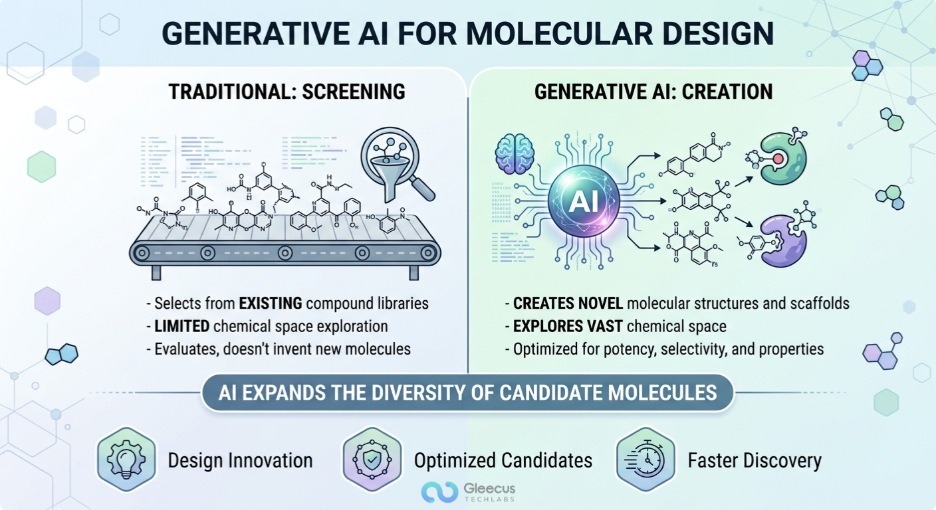
Once a target is selected, the next critical step is designing molecules that can engage it effectively. Generative AI has become one of the most powerful tools in modern drug discovery. These models explore chemical space and propose novel molecular structures optimized for potency, selectivity, synthetic accessibility, and other desired properties.
Unlike traditional virtual screening, which evaluates existing compound libraries, generative approaches can invent entirely new scaffolds. This expands the diversity of candidate molecules and enables the design of compounds that traditional chemistry might never consider. Teams investing in Generative AI Development are using these capabilities to build richer, more innovative pipelines.
AI-Powered Lead Optimization and ADMET Prediction
After initial hits are identified, lead optimization focuses on improving potency while maintaining favorable drug-like characteristics. AI accelerates this stage by predicting how structural modifications will affect biological activity and key ADMET properties (absorption, distribution, metabolism, excretion, and toxicity).
Models trained on historical data can flag potential liabilities early, allowing teams to deprioritize high-risk compounds before significant experimental resources are committed. During iterative design cycles, AI suggests targeted modifications that balance efficacy and safety, reducing the number of synthesis-and-test rounds required.
This predictive capability is especially valuable in complex multi-parameter optimization, where traditional methods struggle to navigate competing objectives simultaneously.
Measurable Impact Across the Discovery Pipeline
When implemented with strong validation and experimental feedback loops, AI delivers clear benefits:
| Stage | Typical Impact of AI |
| Target identification | Higher-confidence prioritization and novel target discovery |
| Molecular design | Generation of diverse, optimizable novel scaffolds |
| Virtual screening | Evaluation of larger chemical libraries in less time |
| Lead optimization | Fewer synthesis cycles and earlier risk detection |
| Overall discovery timelines | Meaningful reduction in cycle times |
| Resource efficiency | Lower experimental attrition and focused wet-lab effort |
These gains improve both the speed and quality of candidates advancing into preclinical development.
Emerging Capabilities – Agentic Systems and Closed-Loop Learning
The next evolution involves agentic AI systems that coordinate multiple research tasks with limited human intervention. Specialized agents can search literature, analyze omics data, propose molecular designs, and suggest experimental priorities. AI Agent Development is enabling more autonomous yet fully auditable discovery workflows that maintain scientific traceability.
Closed-loop approaches that tightly couple AI predictions with automated experimentation further accelerate learning. As new experimental data continuously refine the models, the discovery process becomes self-improving. These capabilities are beginning to transform linear pipelines into adaptive, continuous learning systems.
Challenges and Best Practices for Implementation
Despite the progress, several considerations remain essential:
- High-quality, well-curated data is foundational to reliable model performance
- Explainability and interpretability support scientific trust and regulatory readiness
- Experimental validation remains necessary to confirm computational predictions
- Integration with existing laboratory systems and data infrastructure requires careful planning
- Human oversight and governance frameworks must preserve accountability
Successful adoption treats AI as an augmentation of scientific expertise rather than a replacement. Cross-functional collaboration between computational and experimental teams is critical.
Frequently Asked Questions (FAQs) About AI in Drug Discovery
1. How does AI accelerate target identification in drug discovery?
AI analyzes large multi-omics, genomic, and clinical datasets to uncover disease-associated targets with higher confidence. It detects subtle patterns and causal relationships that traditional methods often miss, helping researchers prioritize biologically relevant and therapeutically tractable targets faster.
2. What is the role of generative AI in molecular design?
Generative AI explores vast chemical space to design novel molecular structures optimized for potency, selectivity, and drug-like properties. Unlike traditional screening of existing libraries, it can invent entirely new scaffolds, expanding the diversity of potential drug candidates.
3. How does AI improve lead optimization?
AI predicts how structural changes will affect biological activity and key ADMET properties (absorption, distribution, metabolism, excretion, and toxicity). This allows teams to refine leads more efficiently, reduce synthesis cycles, and eliminate high-risk compounds earlier in the process.
4. Can AI reduce the overall time and cost of drug discovery?
Yes. By improving target prioritization, enabling generative molecular design, and supporting faster lead optimization, AI can meaningfully shorten discovery cycle times and lower experimental attrition, leading to more efficient use of resources.
5. What are the main challenges when implementing AI in drug discovery?
Key challenges include ensuring high-quality training data, maintaining model explainability, validating predictions experimentally, and integrating AI outputs into existing research workflows while preserving scientific oversight and regulatory readiness.
6. How is agentic AI different from traditional AI tools in drug discovery?
Agentic AI systems can autonomously coordinate multiple research tasks such as literature review, data analysis, molecular design suggestions, and experimental prioritization—while maintaining full traceability. This moves beyond single-task predictions toward more adaptive, multi-step discovery workflows.
Conclusion and Next Steps
AI is accelerating the core stages of drug discovery, target identification, molecular design, and lead optimization, by enabling faster prioritization, generative creation of novel candidates, and earlier prediction of success and risk. Organizations that combine strong data foundations with validated AI capabilities are building more efficient and predictive research engines.
As generative models and agentic systems continue to mature, the discovery process will become increasingly adaptive and data-driven. The opportunity is clear: reduce cycle times, improve candidate quality, and bring innovative therapies to patients more efficiently.
Gleecus TechLabs Inc. partners with pharmaceutical and biotechnology organizations to design and implement practical AI solutions across the discovery continuum. From generative molecular design to intelligent target prioritization and agentic research support, we help teams turn advanced AI into measurable scientific impact.