Clinical trial operations continue to grow in complexity. Protocols are longer, data sources more diverse, and regulatory expectations higher. Teams managing studies must handle protocol queries, source data review, document consistency, enrollment tracking, and continuous monitoring often across fragmented systems. Traditional manual processes struggle to keep pace, creating delays, higher costs, and increased risk of oversight gaps.
AI-Powered Clinical Trial Operations powered by large language models (LLMs), retrieval-augmented generation (RAG), and AI Agents offer a practical path forward. Together, these technologies enable systems that understand clinical language, ground responses in authoritative trial documents, and execute multi-step operational workflows under controlled governance. The result is faster decision support, reduced manual burden, and more consistent execution across the study lifecycle.
The Operational Challenges in Modern Clinical Trials
Clinical operations teams face recurring bottlenecks:
- Time-consuming manual review of lengthy protocols and study documents
- High volumes of data queries and source data verification
- Difficulty synthesizing information across EDC, CTMS, eTMF, labs, and external sources
- Delayed responses to site questions that slow enrollment and retention
- Limited real-time visibility into emerging risks or protocol deviations
These challenges are amplified in complex therapeutic areas and multi-center studies. AI-Powered Clinical Trial Operations address them by combining language understanding, grounded retrieval, and goal-directed action.
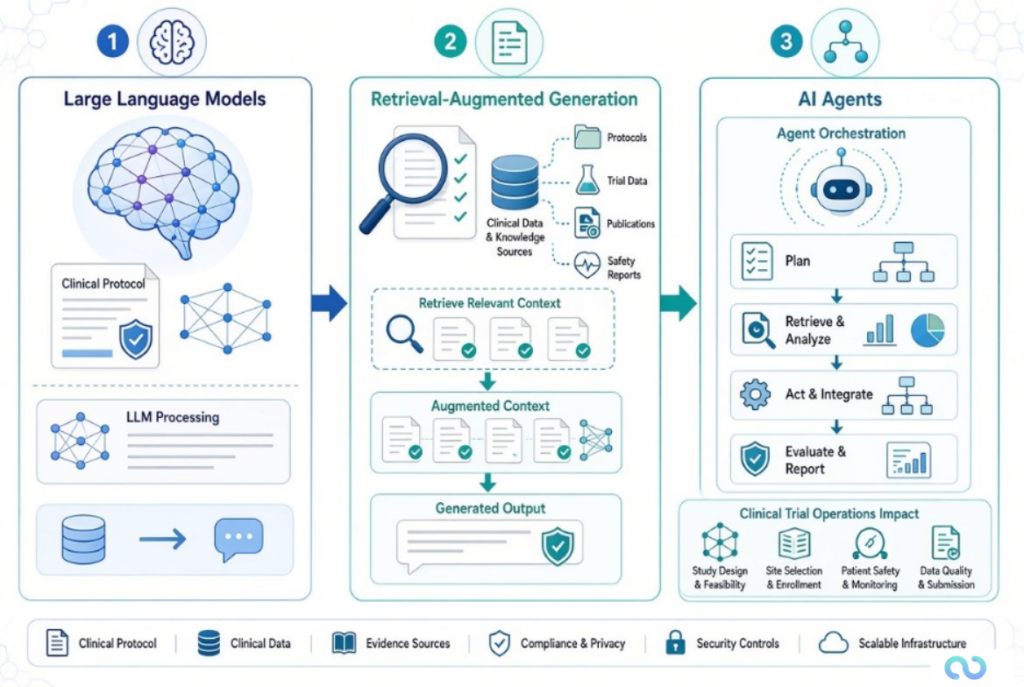
Understanding the Technology Stack – LLMs, RAG, and AI Agents
Large Language Models (LLMs) in Clinical Contexts
LLMs excel at interpreting unstructured clinical text protocols, investigator brochures, case report forms, and site communications. They can summarize complex sections, extract eligibility criteria, draft responses, and map free-text notes to structured concepts. When properly constrained, LLMs reduce the cognitive load on clinical and data teams while accelerating routine language-intensive tasks.
Retrieval-Augmented Generation (RAG) for Grounded Answers
RAG connects an LLM to a curated knowledge base of trial-specific documents, SOPs, regulatory guidance, and literature. Instead of relying solely on pre-trained knowledge, the system first retrieves the most relevant passages and then generates responses grounded in that evidence. This approach significantly reduces hallucinations, improves traceability, and supports audit-ready outputs critical requirements in regulated clinical environments.
RAG has demonstrated clear operational value. Studies of RAG-based assistants for early oncology trial queries have shown substantial reductions in response time while maintaining answer quality, highlighting the technology’s ability to streamline study document support.
AI Agents for Multi-Step Workflow Execution
AI Agents go beyond single-turn generation. They plan sequences of actions, call tools (data systems, document repositories, notification services), observe results, and iterate until a defined goal is reached within explicit guardrails. In clinical operations, agents can prioritize monitoring activities, generate and track queries, review document completeness, flag potential deviations, and escalate exceptions to human experts.
The combination of LLMs for reasoning, RAG for grounded knowledge, and AI Agents for coordinated action creates a powerful foundation for AI-Powered Clinical Trial Operations.
Key Applications Across Clinical Trial Operations
Protocol Understanding and Document Support
LLMs paired with RAG enable rapid, accurate answers to protocol-related questions from sites and internal teams. Agents can retrieve relevant sections, cross-check consistency across documents, and draft structured responses that remain fully traceable to source content. This reduces turnaround time for study queries and supports more consistent interpretation of complex protocols.
Data Review, Query Management, and Monitoring
AI Agents can continuously scan incoming data for outliers, missing values, or potential protocol deviations. They prioritize issues, draft queries, update tracking systems, and route high-risk items for human review. Combined with RAG, agents reference the exact protocol language or data standards that justify each action, strengthening both speed and defensibility.
Enrollment Support and Operational Coordination
Agents assist with eligibility pre-screening support, site performance tracking, and coordination of follow-up actions. By synthesizing information from multiple operational systems and providing natural-language summaries, they help clinical teams focus on decisions rather than data gathering.
These applications illustrate how LLMs, RAG, and AI Agents move clinical operations from reactive problem-solving toward proactive, intelligent support.
Measurable Benefits of AI-Powered Clinical Trial Operations
When designed with strong governance, the technology stack delivers tangible improvements:
| Area | Typical Impact |
|---|---|
| Query & document response time | Significant reduction versus fully manual review |
| Monitoring & data review effort | Faster prioritization and reduced manual workload |
| Study timeline acceleration | Potential compression of key operational milestones |
| Consistency & audit readiness | Grounded, traceable outputs with clear source links |
| Team capacity | Clinical staff freed for higher-judgment activities |
Analyses of agentic monitoring approaches have pointed to meaningful timeline and cost advantages in complex programs, reinforcing the value of moving beyond isolated tools toward coordinated AI-Powered Clinical Trial Operations.
Governance, Validation, and Human Oversight
In regulated clinical research, autonomy must be carefully bounded. Effective implementations emphasize:
- Human-in-the-loop checkpoints for high-impact actions
- Full audit trails of retrieval sources, reasoning steps, and decisions
- Validation against predefined test cases and real study scenarios
- Clear separation of agent permissions and least-privilege access
- Continuous monitoring for performance drift and data quality
These practices ensure that AI Agents augment rather than replace clinical judgment while remaining inspection-ready.
Building the Right Capabilities – Development Considerations
Successful AI-Powered Clinical Trial Operations require more than off-the-shelf models. Organizations benefit from specialized development expertise:
- AI Agent Development for designing multi-step, tool-using systems with robust orchestration and escalation logic
- Generative AI Development for fine-tuning or prompting strategies optimized for clinical language and document generation
- Machine Learning Development for supporting predictive components such as risk scoring, anomaly detection, or enrollment forecasting that complement agentic workflows
Integration with existing clinical systems, rigorous evaluation frameworks, and change management for operational teams are equally critical. Starting with well-scoped, high-volume use cases such as query support or document Q&A allows teams to demonstrate value and build confidence before expanding scope.
Frequently Asked Questions
1. What is the difference between LLMs, RAG, and AI Agents in clinical trial operations?
LLMs understand and generate clinical language from protocols and documents. RAG grounds those responses in verified trial-specific sources to improve accuracy and traceability. AI Agents go further by planning multi-step actions, calling systems, and completing operational tasks under defined guardrails.
2. How does RAG improve the reliability of AI in clinical trials?
RAG retrieves the most relevant passages from protocols, SOPs, study documents, and approved knowledge bases before generating an answer. This reduces hallucinations, ensures responses are evidence-based, and creates a clear audit trail essential for regulated clinical environments.
3. Can AI Agents fully replace human clinical operations staff?
No. Effective implementations keep humans in the loop for high-impact decisions, exceptions, and oversight. AI Agents handle repetitive, high-volume tasks such as prioritization, query drafting, and document checks, freeing clinical teams for judgment-intensive work.
4. What are the main operational benefits of using LLMs, RAG, and AI Agents together?
Organizations typically see faster query resolution, more consistent document support, improved monitoring prioritization, reduced manual workload, and better traceability. When governed properly, these technologies help accelerate key operational milestones while maintaining compliance readiness.
5. What governance practices are required for AI Agents in clinical trials?
Critical practices include human-approval checkpoints, full logging of retrieval sources and actions, least-privilege system access, validation against real study scenarios, and continuous performance monitoring. These controls ensure agents remain audit-ready and aligned with GxP expectations.
6. How should organizations get started with AI-Powered Clinical Trial Operations?
Begin with well-scoped, high-volume use cases such as protocol Q&A or query support. Combine domain expertise with specialized capabilities in AI Agent Development, Generative AI Development, and Machine Learning Development. Focus first on clear metrics, strong data foundations, and human oversight before expanding scope.
Conclusion and Next Steps
LLMs, RAG, and AI Agents are transforming AI-Powered Clinical Trial Operations by enabling systems that understand complex clinical content, ground every answer in authoritative sources, and execute multi-step operational tasks under controlled governance. The combination reduces manual burden, accelerates key processes, and improves consistency across data review, monitoring, document support, and coordination activities.
As trials continue to increase in complexity, organizations that thoughtfully adopt these technologies while maintaining strong validation and human oversight will be better positioned to deliver studies more efficiently and with higher operational quality.
Gleecus TechLabs Inc. partners with life-sciences organizations to design and implement practical solutions that combine LLMs, retrieval-augmented generation, and intelligent agents. From proof-of-concept to production deployment, we help teams turn advanced AI into reliable operational capability.