Enterprises are moving beyond simple automation and chatbots toward systems that can reason, decide, and act. An AI Agent Development Service delivers exactly that: custom-built intelligent agents capable of perceiving context, planning multi-step actions, using enterprise tools, and completing real work with appropriate human oversight.
Unlike basic scripts or rule-based bots, AI agents combine large language models with tool-use capabilities, memory, and orchestration. The result is software that can handle dynamic, decision-heavy workflows across departments. Organizations that invest in a structured AI Agent Development Service gain scalable automation, faster process execution, and the ability to free skilled teams for higher-value work.
What Are AI Agent Development Services?
An AI Agent Development Service encompasses the full lifecycle of designing, building, integrating, testing, deploying, and optimizing autonomous or semi-autonomous AI systems. These services typically include:
- Use-case discovery and feasibility analysis
- Agent architecture and reasoning design
- Model selection and orchestration
- Secure integration with enterprise systems (CRM, ERP, ITSM, databases, APIs)
- Memory and retrieval (often via RAG)
- Guardrails, evaluation frameworks, and human-in-the-loop controls
- Deployment, monitoring, and continuous improvement
The goal is not a conversational interface. It is a production-grade system that accepts a goal or trigger, reasons through options, takes controlled actions, and escalates when needed.
How AI Agents Differ from Chatbots and Traditional Automation
Traditional automation (including classic RPA) follows rigid, predefined rules. Chatbots primarily respond to prompts with information. AI agents go further:
- They perceive context from multiple data sources
- They reason about the best sequence of steps
- They call tools and APIs to perform actions
- They maintain memory across steps or sessions
- They adapt when conditions change, within defined boundaries
This shift from “answer questions” to “complete work” is why demand for professional AI Agent Development Services continues to grow.
Core Capabilities of a Professional AI Agent Development Service
Strategy, Scoping & Architecture Design
Effective projects begin with clear workflow mapping. Teams identify high-friction, high-volume processes where reasoning and multi-step action create measurable value. Architecture decisions cover model choice, orchestration patterns, state management, and the right balance of autonomy versus human oversight.
Tool Integration, Memory & Orchestration
An agent becomes useful only when it can act inside real systems. Development includes secure connectors, function calling, and retrieval pipelines so the agent works from current, permission-aware knowledge. Orchestration layers coordinate planning, tool use, retries, and escalation.
Guardrails, Evaluation & Human-in-the-Loop
Production agents require confidence thresholds, audit logs, policy checks, and defined approval points for high-impact actions. Evaluation suites measure accuracy, safety, latency, and cost. Human-in-the-loop design ensures control without sacrificing efficiency.
These capabilities form the foundation of reliable AI Agent Development. Complementary services such as Generative AI Development and Machine Learning Development often support specialized components within the same ecosystem.
AI Agent Development Across Key Industries
Healthcare
AI agents support clinical and operational workflows by triaging requests, assisting with documentation, coordinating appointments, monitoring data quality, and routing exceptions. Strong governance and privacy controls are essential given regulatory requirements.
Life Sciences
In research and development environments, agents can accelerate literature review, protocol support, data reconciliation, and operational coordination across discovery and clinical stages. Traceability and validation remain critical.
Manufacturing
Agents help monitor production signals, manage exceptions in supply and quality processes, optimize scheduling inputs, and support maintenance workflows. Integration with existing operational technology and ERP systems drives practical value.
Retail
Retail organizations use agents for inventory exception handling, order management support, personalized customer interactions, and internal knowledge assistance. Agents can reduce manual handoffs while improving response consistency.
Banking & Financial Services
In banking, agents assist with transaction monitoring support, customer request triage, document processing, compliance checks, and internal operations. Security, auditability, and controlled autonomy are non-negotiable design requirements.
Across these sectors, the pattern is consistent: start with well-scoped, high-volume workflows, embed strong guardrails, and expand only after proving reliability.
The AI Agent Development Lifecycle
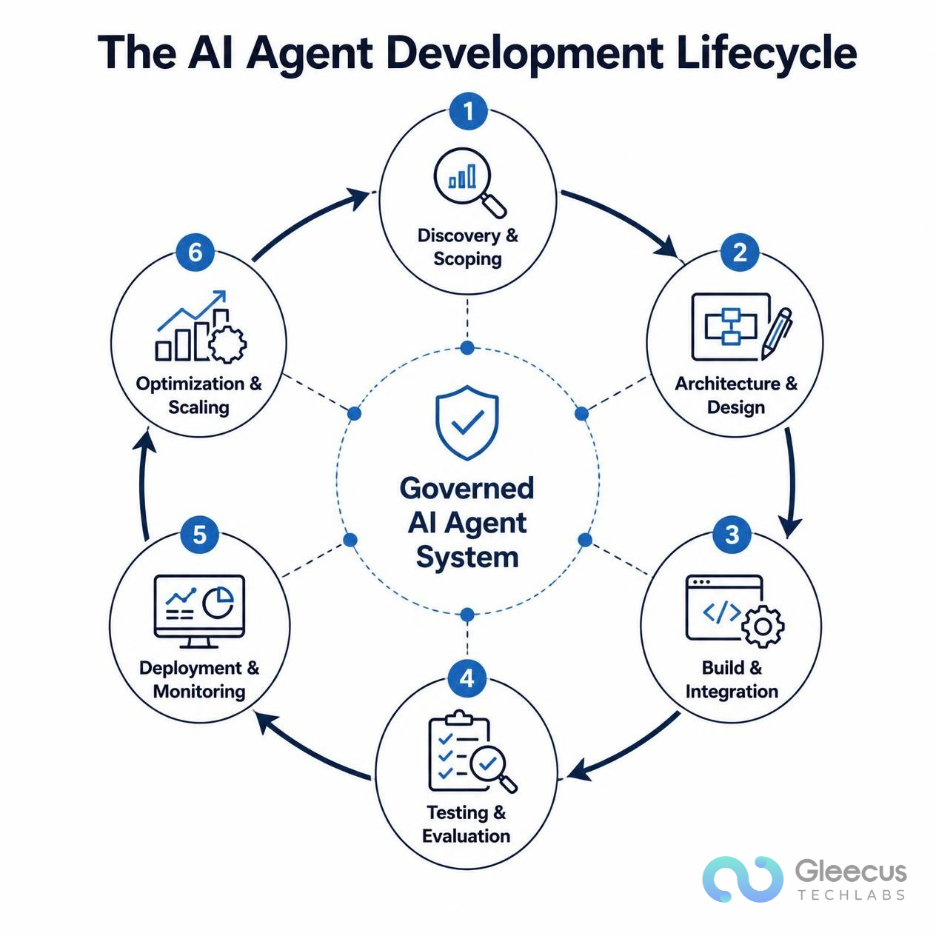
A mature AI Agent Development Service follows a structured lifecycle:
- Discovery and scoping – Map processes, data sources, success metrics, and risk boundaries.
- Architecture and design – Define reasoning approach, tools, memory, and control points.
- Build and integration – Develop the agent, connect systems, and implement retrieval and guardrails.
- Testing and evaluation – Validate behavior against real scenarios, edge cases, and policy requirements.
- Deployment and monitoring – Launch with observability, alerting, and feedback loops.
- Optimization and scaling – Continuously refine performance as data and processes evolve.
This lifecycle treats agents as governed software systems rather than one-off experiments.
Measurable Business Benefits
When implemented thoughtfully, AI Agent Development Services deliver tangible outcomes:
| Benefit Area | Typical Impact |
|---|---|
| Operational efficiency | Reduced manual handoffs and cycle times |
| Scalability | Handle higher volumes without proportional headcount |
| Consistency | Standardized decisions and fewer process variations |
| Employee productivity | Teams focus on judgment and exceptions |
| Response speed | Faster handling of routine and semi-routine work |
| Auditability | Traceable actions and decision logs |
Success depends on choosing the right workflows, defining clear metrics early, and maintaining ongoing oversight.
Key Considerations When Choosing an AI Agent Development Partner
Not every provider delivers production-ready agents. Evaluate partners on:
- Proven experience shipping agents that act inside live enterprise systems
- Strong emphasis on integration, security, and compliance
- Clear evaluation and observability practices
- Human-in-the-loop design for high-stakes actions
- Ability to support post-launch monitoring and improvement
- Transparent approach to architecture, data handling, and ownership
A capable partner combines technical depth with business process understanding and a commitment to governed, maintainable systems.
FAQs on AI Agent Development Services
1. What is an AI Agent Development Service?
An AI Agent Development Service designs, builds, integrates, tests, and deploys intelligent systems that can perceive context, reason through multi-step tasks, use enterprise tools, and take controlled actions—going far beyond basic chatbots or rule-based automation.
2. How is an AI agent different from a chatbot?
Chatbots primarily respond to questions with information. AI agents can plan, call APIs and systems, complete workflows, maintain memory, and escalate exceptions when needed, making them suitable for real operational work.
3. Which industries benefit most from AI Agent Development Services?
Healthcare, life sciences, manufacturing, retail, and banking are among the strongest adopters. Agents help with triage, documentation support, exception handling, inventory and order processes, compliance checks, and internal operations while maintaining necessary controls.
4. What does a typical AI agent development project include?
Projects usually cover use-case scoping, architecture design, tool and system integration, memory/retrieval setup, guardrails and evaluation, human-in-the-loop controls, deployment, and ongoing monitoring and optimization.
5. How long does it take to build a production AI agent?
Timelines vary by complexity. A focused proof-of-concept may take a few weeks, while a production agent with enterprise integrations and strong governance typically requires several months. Multi-agent systems take longer.
6. Do AI agents replace human employees?
No. Well-designed agents handle repetitive, multi-step, or high-volume tasks and surface exceptions for human review. This allows teams to focus on judgment, strategy, and complex decision-making rather than routine work.
Conclusion and Next Steps
An AI Agent Development Service enables organizations to move from reactive automation to proactive, intelligent workflow execution. By combining reasoning models, tool integration, memory, and robust controls, AI agents can take meaningful action across healthcare, life sciences, manufacturing, retail, banking, and other sectors.
The organizations that succeed treat agent development as a strategic capability, starting with high-value use cases, embedding governance from day one, and continuously refining performance. Complementary capabilities in Generative AI Development and Machine Learning Development further strengthen the overall AI ecosystem.
Gleecus TechLabs Inc. partners with enterprises to design, build, and operationalize reliable AI agents that deliver measurable efficiency and decision support. Whether you are exploring your first production agent or scaling a multi-agent environment, we help turn intelligent automation into sustained business impact.