Most AI projects begin with excitement and end in frustration. A promising pilot works well in a controlled demo, yet struggles when real users, real data, and real business rules enter the picture. The usual culprit is not the model itself. It is the absence of a clear Enterprise AI Architecture.
An effective Enterprise AI Architecture treats artificial intelligence as a complete system rather than a single smart component. It defines how requests enter the organization, how they are secured and understood, how knowledge is retrieved, how models are selected, how actions are taken, and how everything is governed and observed. When these pieces work together, AI moves from experimental pilots to reliable production systems that deliver consistent business value.
This guide explains the seven core layers of a modern Enterprise AI Architecture in plain language. The goal is to give technology and business leaders a practical mental model they can apply immediately.
Why Enterprise AI Architecture Matters More Than Model Choice
Selecting the latest large language model is relatively straightforward. Building a system that remains secure, cost-effective, auditable, and useful under daily operational load is far harder. Without proper architecture, teams face common problems: inconsistent answers, uncontrolled costs, missing audit trails, security gaps, and systems that break when traffic increases.
A well-designed Enterprise AI Architecture solves these issues by separating concerns into clear layers. Each layer has a specific job. Governance and observability run vertically across every layer so that control and visibility are never afterthoughts. The result is an AI capability that behaves like any other critical enterprise system—predictable, measurable, and scalable.
The 7 Layers of Enterprise AI Architecture
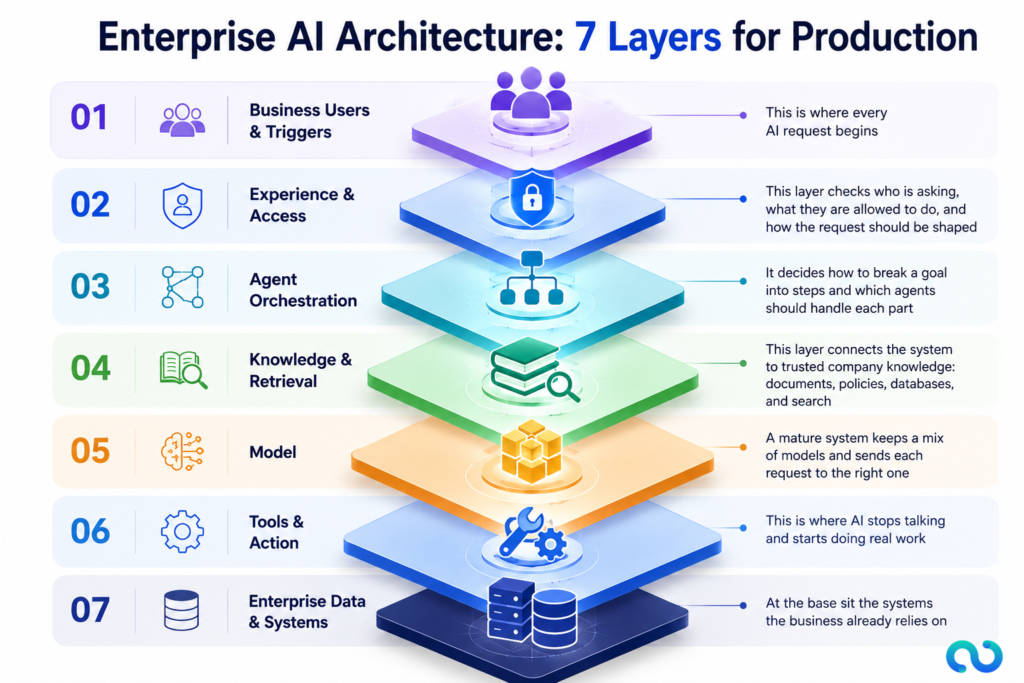
Every production request travels through seven layers. The request moves downward through the stack. The response travels back upward, fully instrumented with tracing, cost data, and quality signals.
Layer 1: Business Users and Triggers
Every AI interaction begins with a person, a system, or an automated event. Employees may start an internal process. Customers may ask questions through a website or app. Systems may send API events. Scheduled jobs may launch overnight workflows.
Strong Enterprise AI Architecture designs for these real triggers rather than idealized chat demos. Many of the highest-value enterprise use cases run without a human watching the screen. Architecture must therefore support both conversational and unattended modes from day one.
Layer 2: Experience and Access
This layer acts as the controlled front door. Before any request reaches an AI agent, it must be authenticated, authorized, and properly shaped.
Key responsibilities include routing and rate limiting, identity verification, session continuity across multiple turns, and careful assembly of the working context. Context is not simply a long prompt. It is a carefully engineered package of user identity, relevant history, policy constraints, and task instructions. Treating context assembly as an engineering discipline dramatically improves reliability and safety.
Layer 3: Agent Orchestration
Orchestration is the brain of the system. It decides how a goal should be broken into steps, which specialized agents should handle each step, when to retry or branch, and when to pause for human approval.
This layer typically includes routing logic, planning and decomposition, supervisor agents that review work, workflow engines that manage state, short-term and long-term memory, and approval gates for sensitive actions. Without solid orchestration, AI systems remain fragile demos. With it, they become dependable systems that can handle complex, multi-step work.
Layer 4: Knowledge and Retrieval
An AI system is only as useful as the enterprise knowledge it can reach. This layer connects agents to trusted information through enterprise search, retrieval-augmented generation pipelines, vector databases, knowledge graphs, document repositories, and structured data sources.
High-quality retrieval often delivers more business value than simply using a larger model. When agents can reliably find the right policies, procedures, customer records, or operational data, hallucinations drop and trust rises.
Layer 5: Model Layer
No single model is best for every task. A mature Enterprise AI Architecture maintains a portfolio of models and routes each request intelligently.
Deep reasoning tasks may use powerful foundation models. High-volume or simpler tasks can use smaller, faster, and less expensive models. Embeddings support semantic search. Rerankers improve the precision of retrieved results. Intelligent routing sending the majority of traffic to smaller models—frequently produces the largest cost and performance gains.
Layer 6: Tools and Action
This is the layer where AI stops generating text and begins performing real work. Agents interact with business applications, CRM and ERP systems, email and calendar tools, databases, code execution environments, automation platforms, and external APIs.
Every tool call must carry clear permissions. Capability without control creates risk. Proper permission models, logging, and approval paths turn AI from a conversational assistant into a controlled operating system for business processes.
Layer 7: Enterprise Data and Systems
At the foundation sit the systems the business already runs: policies, standard operating procedures, tickets, documents, data lakes, operational applications, and telemetry. AI does not replace these systems. A good Enterprise AI Architecture makes them far more accessible and actionable.
Vertical Capabilities That Run Across All Layers
Two critical capabilities cut vertically through the entire stack.
Security, Governance, and Compliance
Guardrails, privacy controls, policy enforcement, and immutable audit trails must wrap every layer on every call. Treating governance as a final checkpoint invites bypasses. Embedding it as a continuous wrapper keeps systems safe and compliant as they scale.
Observability, Evaluation, and Feedback
Teams cannot improve what they cannot see. Every decision should be traceable. Costs should be attributable to outcomes. Latency and quality should be measured continuously. Feedback loops allow the system to improve from real usage rather than only from laboratory tests. Traceability first, scale second remains a reliable rule.
The Runtime Foundation
Above the seven layers sits the runtime and infrastructure that make the architecture real: cloud or on-premises environments, containers, queues, caching, secrets management, and monitoring. These “boring” components determine whether clever designs survive real traffic, real cost pressure, and real operational demands. Shipping solid foundations early protects the investment in the higher layers.
Practical Principles for Building Enterprise AI Architecture
- Begin with the actual trigger and the business outcome, not with model selection.
- Prioritize retrieval quality; grounded answers outperform larger but ungrounded models.
- Enforce permissions and approvals on every action that changes state.
- Instrument everything from the first pilot so costs, quality, and failures are visible.
- Route work to the smallest capable model to control cost and latency.
These principles keep architecture focused on production reality rather than laboratory novelty.
Moving from Pilot to Production
A complete Enterprise AI Architecture gives organizations a shared language and a clear checklist. Leaders can assess existing pilots against the seven layers and two vertical spines, identify missing controls, and prioritize the investments that unlock reliable scale.
At Gleecus TechLabs Inc., we help enterprises design, review, and implement production-grade AI systems using this layered approach. The result is AI that operates with the same discipline as other mission-critical platforms—secure, observable, cost-aware, and aligned with business goals.