Healthcare claim denials continue to drain revenue, increase administrative burden, and delay cash flow for providers. Industry reports show that a significant share of organizations now face denial rates of 10% or higher, driven by data inaccuracies, authorization gaps, coding issues, and incomplete documentation. Many of these denials are preventable. Retrieval-Augmented Generation (RAG) combined with AI Agents offers a practical path to reduce healthcare claim denials by improving accuracy before submission and accelerating recovery when denials occur.
This article explains how RAG and AI Agents work together across the claims lifecycle, the specific ways they address root causes of denials, and the operational benefits organizations can expect when these technologies are implemented with proper governance.
The Growing Challenge of Healthcare Claim Denials
Claim denials remain one of the most persistent problems in healthcare revenue cycle management. Common root causes include:
- Missing or inaccurate patient and insurance data
- Authorization and eligibility issues
- Coding and modifier errors
- Insufficient clinical documentation for medical necessity
- Failure to meet payer-specific rules and timely filing requirements
Each denial triggers rework, delayed reimbursement, and additional staff time. High volumes of preventable denials also increase days in accounts receivable and create frustration for both clinical and administrative teams. Traditional rule-based systems and manual reviews struggle to keep pace with evolving payer policies and the volume of claims processed daily.
This is where modern AI approaches particularly RAG grounded in authoritative sources and AI Agents that can act across workflows provide a more adaptive and scalable solution.
Understanding RAG and AI Agents in Revenue Cycle Management
What Is Retrieval-Augmented Generation (RAG)?
RAG enhances large language models by retrieving relevant, up-to-date information from trusted knowledge sources before generating a response. In the context of healthcare claims, RAG can pull from payer policy documents, clinical guidelines, coding standards, historical denial patterns, and internal knowledge bases. This grounding reduces hallucinations and produces outputs that cite specific, verifiable sources critical for auditability and compliance.
What Are AI Agents in This Context?
AI Agents are systems that can perceive context, reason through multi-step tasks, use tools and data sources, and take defined actions (or escalate to humans). In revenue cycle operations, AI Agents can verify eligibility, validate codes against payer rules, assemble clinical evidence, draft appeal letters, and route tasks—all while operating under governance controls and human-in-the-loop checkpoints.
When RAG supplies grounded knowledge and AI Agents orchestrate actions, the combination becomes especially powerful for reducing healthcare claim denials.
How RAG and AI Agents Prevent Claim Denials Upstream
The highest-value opportunity is prevention. RAG and AI Agents can intervene before a claim is submitted:
- Eligibility and benefits verification – AI Agents query live or near-real-time sources and use RAG to interpret complex plan details, flagging coverage mismatches, high-deductible risks, or missing authorizations.
- Pre-submission claim validation – Agents cross-check coding, modifiers, documentation completeness, and payer-specific edits. RAG retrieves the latest policy language and coding guidelines so validations stay current.
- Documentation gap detection – By retrieving clinical notes and structured data, agents identify missing elements required for medical necessity and prompt for clarification before the claim leaves the system.
- Risk scoring – Historical denial patterns combined with RAG-retrieved payer rules help prioritize high-risk claims for additional review.
These upstream checks improve first-pass yield and reduce the volume of preventable healthcare claim denials entering the system.
How RAG and AI Agents Improve Denial Triage and Appeals
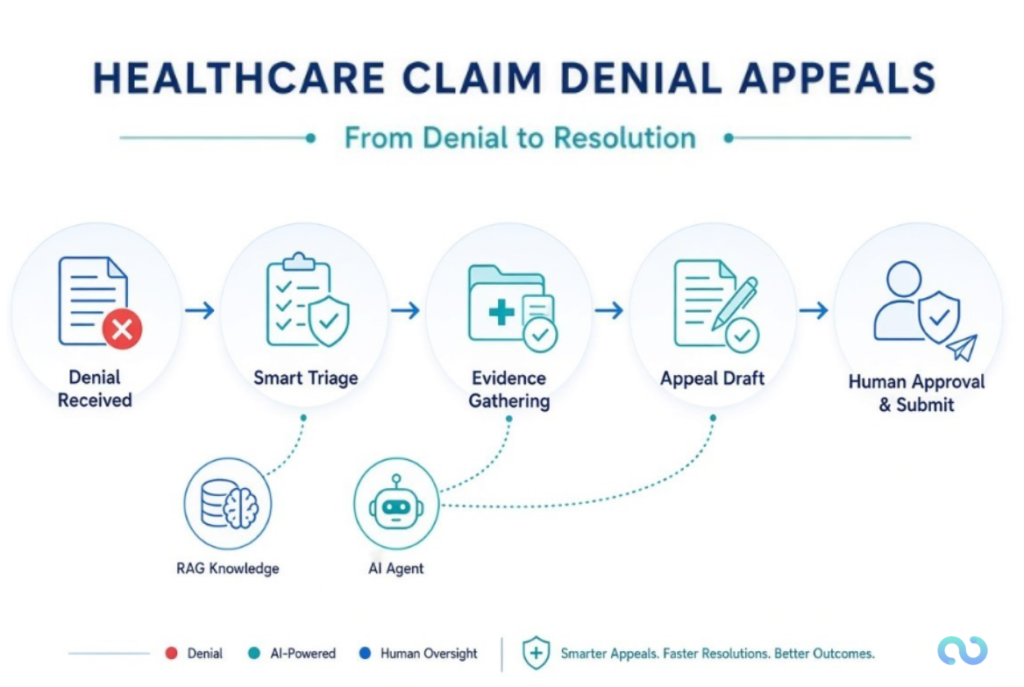
Even with strong prevention, some denials will occur. RAG and AI Agents accelerate recovery:
- Intelligent triage – Agents classify denials by reason code, dollar amount, payer, and likelihood of successful appeal, then route work to the appropriate team or workflow.
- Evidence assembly – RAG retrieves relevant clinical documentation, coding rationale, and policy citations. Agents organize this material into structured case packets.
- Appeal drafting – Using retrieved evidence and payer-specific templates, agents generate first-draft appeal letters that cite sources and follow required formats. Human reviewers then refine and approve.
- Outcome tracking and learning – Agents log results and feed successful patterns back into knowledge bases, continuously improving future performance.
This combination shortens appeal cycle times, raises overturn rates on targeted categories, and reduces the manual effort required for each case.
Key Benefits and Measurable Impact
Organizations applying RAG and AI Agents to healthcare claim denials commonly report improvements in several areas:
| Area | Typical Impact |
|---|---|
| Denial rate reduction | Meaningful decreases on preventable categories |
| Appeal cycle time | Faster preparation and submission of appeals |
| Clean claim / first-pass rates | Higher rates through upstream validation |
| Staff productivity | Reduced time spent on routine verification and drafting |
| Audit readiness | Better traceability via source citations and logs |
| Cash flow | Lower days in A/R and improved recovery rates |
Results vary by organization size, data quality, and the specific denial categories targeted. Success depends on starting with high-volume, well-defined use cases and maintaining strong governance.

Implementation Considerations and Best Practices
Effective deployment of RAG and AI Agents for healthcare claim denials requires attention to several factors:
- Data quality and integration – Accurate, accessible clinical, billing, and payer data form the foundation.
- Governance and human-in-the-loop design – High-impact actions (submissions, appeals, code changes) should include clear approval points and full audit trails.
- Policy and knowledge freshness – RAG sources must be kept current as payer rules and coding standards evolve.
- Security and compliance – Systems handling protected health information require appropriate controls, minimum-necessary access, and logging.
- Evaluation and continuous improvement – Track denial rates, overturn rates, cycle times, and accuracy; refine agents and retrieval strategies based on results.
Complementary capabilities such as AI Agent Development, Generative AI Development, and Machine Learning Development support the full spectrum of needs from building specialized agents to refining predictive models that score denial risk.
Starting with a focused pilot (for example, eligibility verification or a single high-volume denial category) allows teams to demonstrate value, refine processes, and scale with confidence.
Frequently Asked Questions
1. How can RAG help reduce healthcare claim denials?
RAG grounds AI outputs in current payer policies, coding standards, clinical guidelines, and historical denial data. This improves the accuracy of validations, documentation checks, and appeal justifications while providing traceable source citations.
2. What role do AI Agents play in managing claim denials?
AI Agents can verify eligibility, validate claims before submission, triage denials, assemble clinical evidence, draft appeal letters, and route tasks reducing manual effort and accelerating both prevention and recovery.
3. Can RAG and AI Agents prevent denials before claims are submitted?
Yes. They support real-time or near-real-time eligibility checks, coding and documentation validation against payer rules, risk scoring of claims, and identification of missing elements required for medical necessity.
4. How do these technologies improve the appeals process?
AI Agents use RAG to retrieve relevant documentation and policy language, then draft structured, payer-specific appeal packets. This shortens cycle times, improves consistency, and raises the quality of submissions while keeping humans in the approval loop.
5. What results can organizations typically expect?
Reported outcomes include reductions in preventable denial rates, faster appeal turnaround, higher first-pass claim rates, and lower staff time spent on routine verification and drafting. Actual results depend on data quality, scope, and governance.
6. What are the main implementation considerations?
Key factors include data integration and quality, human-in-the-loop controls, keeping knowledge sources current, security and compliance (including PHI handling), and continuous evaluation of performance metrics.
Conclusion
Healthcare claim denials remain a costly and persistent challenge, but they are increasingly addressable with the right combination of technologies. RAG provides grounded, up-to-date knowledge from policies, guidelines, and historical data. AI Agents bring the ability to reason across steps, use tools, assemble evidence, and act within defined boundaries. Together, they enable stronger prevention upstream and faster, more effective recovery when denials occur.
Organizations that implement these capabilities thoughtfully prioritizing data quality, governance, and measurable outcomes can reduce preventable denials, improve staff productivity, and strengthen financial performance. The path forward begins with clear use cases, reliable retrieval foundations, and agents designed for healthcare’s regulatory and operational realities.
Gleecus TechLabs Inc. partners with healthcare organizations to design and deploy practical RAG and AI Agent solutions that target the root causes of claim denials. Whether the priority is pre-submission validation, intelligent triage, or accelerated appeals, we help turn advanced AI into measurable revenue cycle improvement.