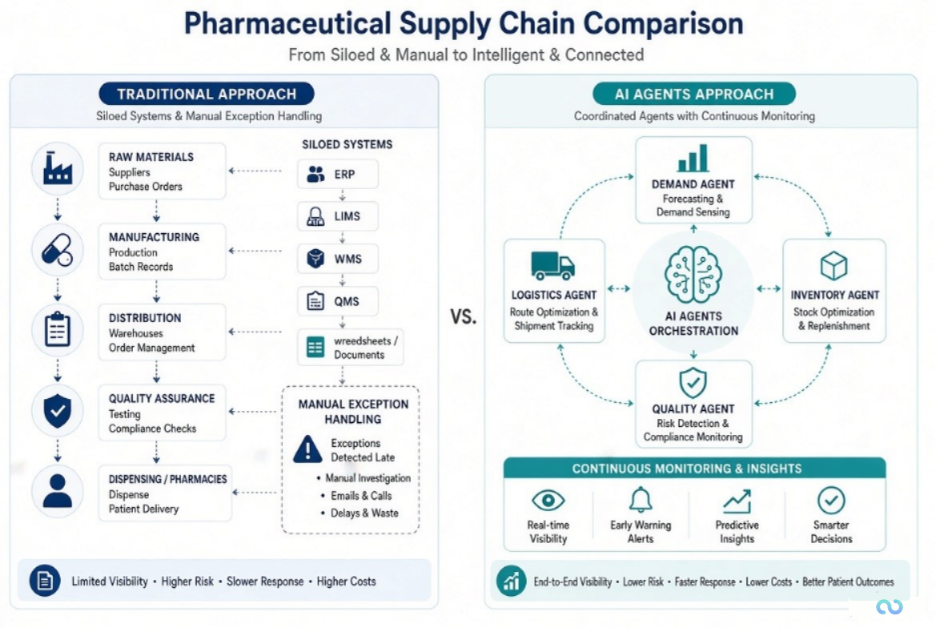
Pharmaceutical supply chains are among the most complex in any industry. They must balance strict regulatory requirements, temperature-sensitive products, multi-echelon networks, quality release processes, and the critical need to ensure medicines reach patients without interruption. Traditional approaches to pharmaceutical supply chain management often built on periodic planning, manual exception handling, and siloed systems struggle to keep pace with real-time variability in demand, manufacturing, logistics, and quality.
Agentic AI is changing this dynamic. AI Agents can monitor signals across the network, reason over goals, coordinate multi-step actions, and execute within defined guardrails. This shift is transforming pharmaceutical supply chain management from reactive and fragmented to more proactive, continuous, and resilient.
The Complexity of Pharmaceutical Supply Chain Management
Pharmaceutical supply chains face unique challenges:
- High interdependence between manufacturing, quality release, logistics, and distribution
- Strict cold-chain and serialization requirements
- Variable yields, capacity constraints, and quality holds
- Global supplier networks and multi-tier visibility gaps
- Regulatory expectations for traceability and auditability
When a delay occurs in quality release, a supplier misses a lead time, or demand shifts unexpectedly, traditional systems often require manual investigation and sequential approvals. This slows response and increases the risk of stockouts, excess inventory, or service failures. The result is higher cost, lower resilience, and greater pressure on planning and operations teams.
What Agentic AI Brings to Supply Chain Management
AI Agents differ from basic automation or predictive models. They can perceive real-time data, plan multi-step responses, use tools across systems, and act within approved boundaries while escalating when human judgment is required.
In pharmaceutical supply chain management, AI Agents can:
- Continuously monitor inventory, orders, shipments, and quality status
- Detect emerging risks before they impact service
- Recommend or execute adjustments such as reallocation, alternate sourcing, or prioritization
- Coordinate across planning, procurement, manufacturing, and logistics
- Maintain full audit trails for compliance
This creates a more dynamic operating model in which routine coordination and exception handling are accelerated, while human experts focus on strategy, complex trade-offs, and oversight.
Understanding the broader state of AI across the pharmaceutical value chain helps organizations prioritize high-impact opportunities. For a comprehensive view of current adoption and emerging patterns, explore our whitepaper on the state of AI in pharma.

How AI Agents Transform Core Supply Chain Processes
Demand Sensing and Inventory Optimization
AI Agents can continuously refine demand signals by incorporating real-time orders, market indicators, and historical patterns. They support inventory decisions that balance service levels with holding costs and expiry risk, particularly important for specialty and temperature-sensitive products. Machine Learning Development underpins the predictive models that feed these agents with accurate forecasts and risk scores.
Exception Management and Disruption Response
When a shipment is delayed, a quality hold extends, or a supplier signals capacity issues, AI Agents can assess downstream impact, evaluate alternatives, and initiate approved responses. This compresses the time between detection and action and reduces the manual coordination burden on planners and logistics teams.
Procurement, Quality, and Logistics Coordination
AI Agents can bridge traditionally siloed functions. A procurement-focused agent may monitor supplier performance and trigger reorders within policy limits. A quality-aware agent can factor release timelines into available-to-promise calculations. Logistics agents can re-route or re-prioritize shipments based on real-time conditions. AI Agent Development enables the creation of these specialized, goal-driven agents that operate across systems while respecting governance rules.
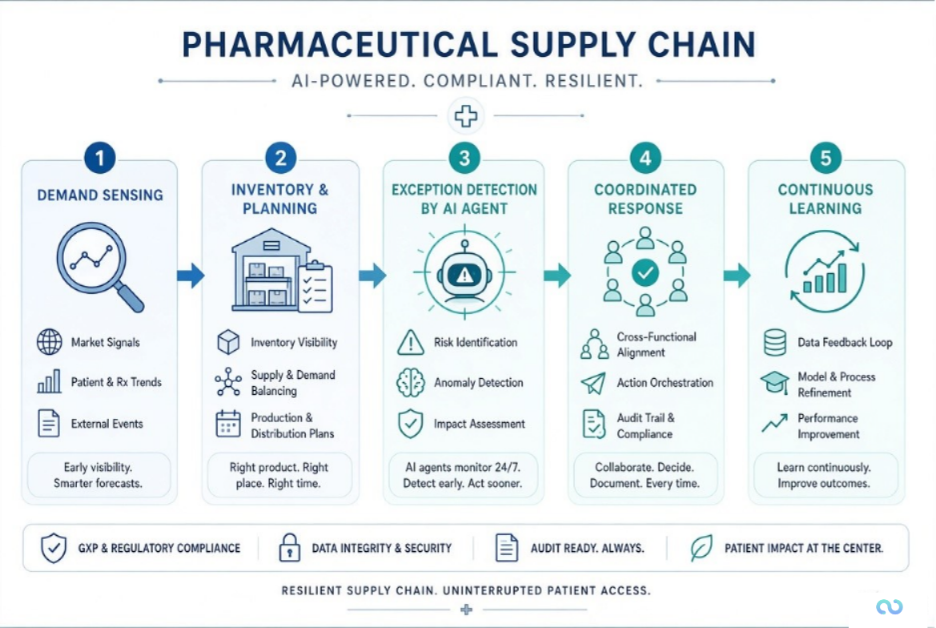
These capabilities allow pharmaceutical supply chain management to move from periodic, human-driven adjustments toward continuous, intelligent orchestration.
Key Benefits for Pharmaceutical Organizations
| Benefit Area | Impact on Pharmaceutical Supply Chain Management |
|---|---|
| Responsiveness | Faster detection and response to disruptions |
| Inventory efficiency | Better balance of service levels and working capital |
| Service reliability | Reduced stockouts and improved on-time performance |
| Planning productivity | Less time spent on routine coordination and data gathering |
| Resilience | Stronger ability to absorb variability and recover quickly |
| Compliance readiness | Transparent, auditable decision trails |
Organizations that embed AI Agents thoughtfully report measurable improvements in cycle times, exception handling, and overall network visibility. The same intelligence layer also supports related operational needs. Generative AI Development can help generate clear exception summaries, scenario explanations, and stakeholder communications that keep teams aligned.
Implementation Considerations and Governance
Successful adoption of AI Agents in pharmaceutical supply chain management depends on several factors:
- Clear definition of agent goals, decision rights, and escalation thresholds
- Secure integration with ERP, WMS, TMS, quality systems, and serialization platforms
- Human-in-the-loop design for high-impact or irreversible actions
- Robust audit trails and model governance aligned with regulatory expectations
- Change management that elevates planners and operators into oversight and exception roles
Starting with high-volume, well-defined use cases such as inventory alerts, shipment exception triage, or supplier performance monitoring allows teams to demonstrate value, refine controls, and expand with confidence.
Pharmaceutical supply chain transformation does not occur in isolation. Parallel advances in manufacturing, quality, and commercial operations show how agentic systems can improve end-to-end performance when designed with appropriate safeguards and human accountability.
Frequently Asked Questions
1. How do AI Agents improve pharmaceutical supply chain management?
AI Agents continuously monitor signals, detect risks early, coordinate multi-step responses, and support or execute actions within defined guardrails, reducing cycle times and improving resilience.
2. What is the difference between traditional automation and AI Agents in supply chains?
Traditional automation follows fixed rules. AI Agents can reason over goals, adapt to changing conditions, use multiple tools, and coordinate across systems while escalating when needed.
3. Which supply chain processes benefit most from AI Agents?
Demand sensing, inventory optimization, exception management, supplier monitoring, quality-aware planning, and logistics coordination are among the highest-value starting points.
4. Do AI Agents replace supply chain planners?
No. They handle routine monitoring and coordination so planners can focus on strategy, complex trade-offs, and oversight.
5. What governance is required for AI Agents in pharmaceutical supply chains?
Clear decision rights, escalation rules, secure system integration, human-in-the-loop controls for high-impact actions, and full audit trails aligned with regulatory expectations.
6. How do AI Agents support compliance in pharmaceutical supply chains?
By maintaining transparent decision logs, respecting approved policies, and integrating with serialization and quality systems, AI Agents can strengthen both operational performance and audit readiness.
Conclusion
Agentic AI is transforming pharmaceutical supply chain management by enabling continuous monitoring, intelligent exception handling, and coordinated action across complex networks. AI Agents handle routine coordination and first-response activities while human experts retain control over strategy, complex trade-offs, and final accountability.
The result is a more resilient, responsive, and efficient supply chain—one better equipped to ensure that medicines reach patients reliably even amid variability and disruption.
Gleecus TechLabs Inc. partners with pharmaceutical organizations to design and deploy AI Agents that strengthen supply chain management while meeting the rigorous requirements of regulated environments. Whether the priority is demand sensing, exception management, or end-to-end orchestration, we help turn advanced AI into practical, measurable outcomes.