Retail customer experience has long relied on digital assistants to handle routine questions and guide shoppers. For years, traditional chatbots served this role in answering FAQs, directing customers to product pages, and escalating complex issues to human agents. While useful for basic interactions, traditional chatbots often fall short when customers need deeper help, multi-step support, or truly personalized assistance.
Agentic AI changes this dynamic. AI Agents move beyond scripted responses. They understand context, reason through goals, connect to business systems, and take meaningful actions on behalf of customers. This shift is transforming retail customer experience by making interactions more helpful, continuous, and outcome-oriented.
The Limits of Traditional Chatbots in Retail
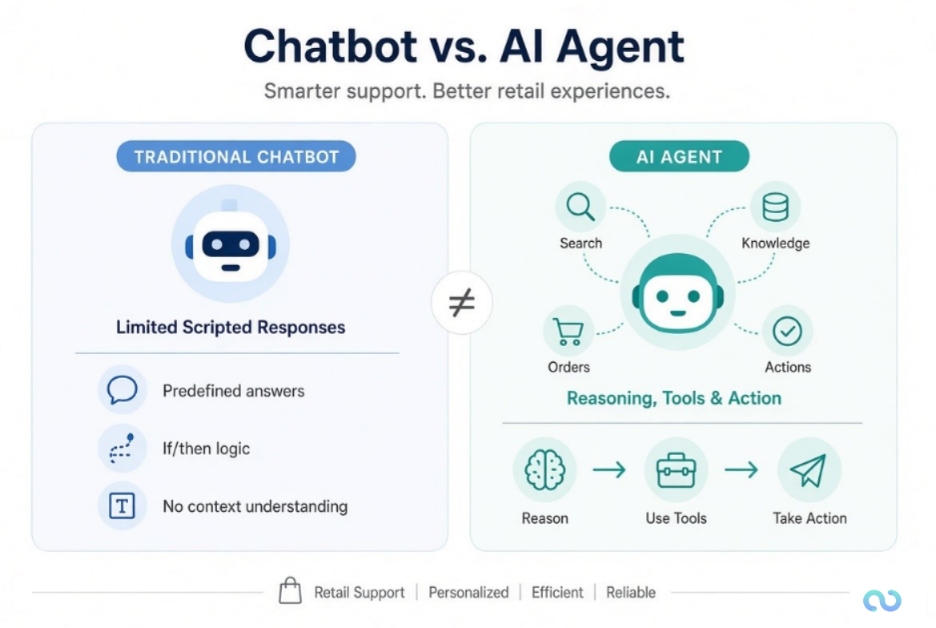
Traditional chatbots typically operate on predefined rules, intent matching, or limited conversational flows. They excel at answering common questions such as store hours, return policies, or basic product information. However, they struggle with:
- Complex or multi-intent requests
- Maintaining context across a full shopping journey
- Accessing live inventory, order systems, or personalization data in a coordinated way
- Taking actions such as processing a return, updating an address, or building a tailored product recommendation set
When a customer asks something outside the scripted path, traditional chatbots often provide generic answers, dead-end links, or force a handoff to a human agent. This creates friction, longer resolution times, and inconsistent experiences especially during peak periods when support teams are stretched.
Retail customer experience today demands more than reactive answers. Shoppers expect assistance that understands their goals, remembers prior context, and helps complete tasks efficiently.
What Are AI Agents and How Do They Differ?
AI Agents are goal-driven systems that can observe customer signals, plan multi-step actions, use tools and data sources, and execute tasks within defined guardrails. Unlike traditional chatbots that primarily respond to queries, AI Agents actively work toward outcomes.
From Reactive Scripts to Goal-Driven Action
A traditional chatbot might reply to “Where is my order?” with a tracking link. An AI Agent can retrieve live order status, explain delays in plain language, offer proactive options (such as a discount or alternative delivery), update internal systems if needed, and confirm next steps all while preserving full context for any human escalation.
This ability to reason, act, and maintain continuity is what elevates AI Agents beyond traditional chatbots and unlocks higher-quality retail customer experience.
Understanding the difference between traditional chatbots and AI Agents is only the starting point. The real transformation in retail customer experience comes from combining agentic systems with generative intelligence to create more responsive, personalized, and continuous interactions.
How AI Agents Elevate Retail Customer Experience
AI Agents improve retail customer experience across discovery, purchase, and post-purchase stages.
Personalized Discovery and Guided Selling
Shoppers often struggle with overwhelming product catalogs or vague search results. AI Agents interpret natural language requests (“I need a waterproof jacket for hiking in rainy weather under a certain budget”), apply preference and context filters, check real-time availability, and present curated options. They can also surface complementary items and explain why recommendations fit the customer’s needs, improving conversion and average order value.
Personalized recommendations become far more effective when generative capabilities help craft relevant product narratives, style suggestions, or use-case explanations in real time. Combining these strengths with AI Agents allows retailers to move beyond generic suggestions toward truly tailored journeys. Teams exploring generative approaches for retail often start by examining how generative AI supports personalized customer journeys at scale.
AI Agents do more than respond to queries; they actively orchestrate the retail customer journey. From understanding intent during discovery to coordinating post-purchase actions, they create continuity that traditional chatbots cannot match. For a deeper look at how these systems coordinate multi-step interactions across channels, explore how AI Agents orchestrate the full retail customer journey.
Autonomous Support Across the Journey
Common post-purchase requests order status, returns, refunds, address changes, or subscription adjustments can be resolved end-to-end by AI Agents connected to order management, inventory, and payment systems. This reduces wait times and frees human agents for higher-value or sensitive cases.
Proactive Engagement and Continuity
AI Agents can detect signals such as delayed shipments, abandoned carts, or restocked preferred items and reach out with relevant, timely assistance. Because they carry context across channels and interactions, customers do not need to repeat information. This continuity strengthens trust and satisfaction.
Key Benefits for Retailers and Shoppers
The combination of reasoning, tool use, and action capability delivers measurable advantages:
| Benefit Area | Impact on Retail Customer Experience |
|---|---|
| Resolution speed | Faster handling of routine and multi-step requests |
| Personalization | Context-aware recommendations and support |
| Conversion & AOV | Better product discovery and guided selling |
| Cost to serve | Reduced volume of simple tickets handled by humans |
| Consistency | Uniform quality across channels and peak periods |
| Human agent focus | Teams handle complex or high-empathy interactions |
When implemented thoughtfully, AI Agents contribute to higher satisfaction, faster resolution, and more consistent experiences. Retail brands that focus on elevating overall customer experience through intelligent systems often see stronger loyalty and operational efficiency. Understanding the broader role of AI in shaping retail customer experience helps teams prioritize the highest-impact opportunities.
Practical Use Cases Across the Customer Journey
AI Agents deliver value at multiple points:
- Pre-purchase – Intent-aware product discovery, style or use-case matching, size and availability guidance
- During purchase – Cart assistance, promotion application, shipping option explanation, checkout friction reduction
- Post-purchase – Order tracking with proactive updates, return eligibility checks and label generation, refund processing within policy, subscription management
- Ongoing relationship – Restock alerts, personalized offers based on history, feedback collection and routing
These capabilities turn isolated interactions into a connected retail customer experience that feels more helpful and less fragmented.
Implementation Considerations for Retail Teams
Successful adoption of AI Agents requires more than technology. Key considerations include:
- Clear definition of goals and allowed actions for each agent
- Secure integration with inventory, order, CRM, and payment systems
- Human-in-the-loop design for sensitive decisions and escalations
- Continuous evaluation of accuracy, resolution rates, and customer feedback
- Alignment with brand voice and compliance requirements
Successful adoption depends on clear goals, secure integrations, and ongoing refinement. Building these capabilities typically involves specialized expertise in AI Agent Development for goal-driven systems that can act across tools and data sources. Supporting personalization and content generation benefits from Generative AI Development, while predictive elements such as demand signals or risk scoring draw on Machine Learning Development. Together, these disciplines enable retailers to move from traditional chatbots to more capable, outcome-oriented assistants.
Starting with high-volume, well-defined use cases (such as order status or returns) allows teams to demonstrate value, refine guardrails, and expand confidently.
Frequently Asked Questions
1. How do AI Agents differ from traditional chatbots in retail?
Traditional chatbots follow scripts or limited intents and mainly provide answers or links. AI Agents understand goals, plan multi-step actions, connect to business systems, and complete tasks such as checking inventory, processing returns, or guiding product selection.
2. Can AI Agents improve retail customer experience beyond basic support?
Yes. They enhance personalized discovery, guided selling, proactive notifications, and continuous support across the shopping journey while reducing friction and resolution times.
3. What retail use cases benefit most from AI Agents?
High-volume scenarios such as product discovery, order status inquiries, returns and refunds, cart assistance, and subscription management typically deliver early value.
4. Do AI Agents replace human customer service teams?
No. AI Agents handle routine and multi-step tasks at scale. Human agents focus on complex, high-empathy, or exception cases, often with full context provided by the AI Agent.
5. What is required to implement AI Agents successfully in retail?
Clear goals and guardrails, secure system integrations, human oversight for sensitive actions, continuous performance monitoring, and alignment with brand and compliance standards.
6. How do AI Agents support better conversion and customer satisfaction?
By delivering relevant recommendations, reducing friction at key moments, maintaining context across interactions, and resolving issues faster, AI Agents contribute to higher conversion, improved average order value, and stronger satisfaction scores.
Conclusion
Traditional chatbots helped retailers handle basic inquiries at scale, but they were never designed for the full complexity of modern retail customer experience. AI Agents represent the next step: systems that understand intent, maintain context, reason through multi-step goals, and take action across systems.
By moving from reactive answers to goal-driven assistance, AI Agents improve discovery, accelerate support, increase continuity, and free human teams for higher-value work. Retailers that invest in well-governed AI Agents position themselves to meet rising customer expectations while operating more efficiently.
Gleecus TechLabs Inc. partners with retail organizations to design and implement AI Agents that transform customer experience beyond the limitations of traditional chatbots. Whether the priority is intelligent product guidance, autonomous post-purchase support, or proactive engagement, we help turn advanced AI into practical, measurable outcomes.