Quality Management Systems sit at the heart of life sciences operations. They govern deviations, CAPAs, complaints, change control, training, and audit readiness processes that directly affect patient safety, regulatory compliance, and operational efficiency. Traditional Quality Management Systems, while essential, often rely on manual data gathering, fragmented systems, and reactive workflows. This creates delays, inconsistent investigations, and heavy administrative burden on quality teams.
Agentic AI is changing this landscape. AI Agents can observe signals, retrieve information across systems, reason through multi-step quality workflows, and prepare evidence-based recommendations all under human oversight. This shift is helping life sciences organizations move from reactive quality management toward more proactive, consistent, and efficient Quality Management Systems.
The Challenges of Traditional Quality Management Systems
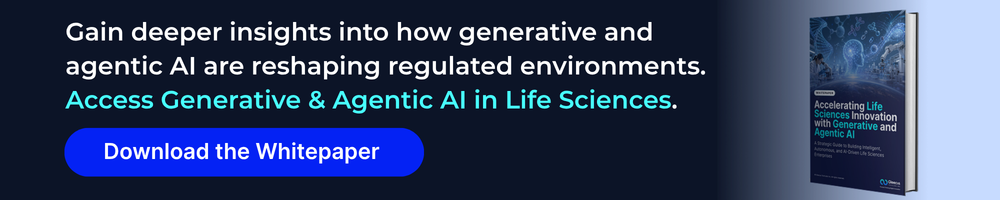
In life sciences, quality processes are highly regulated and documentation-intensive. Common pain points include:
- Time-consuming deviation investigations that require pulling data from multiple systems
- Inconsistent root cause analysis and CAPA documentation
- Manual correlation of complaints, batch records, and historical events
- Lengthy audit preparation and change impact assessments
- Limited ability to detect emerging patterns before they escalate
These challenges slow cycle times, increase the risk of incomplete investigations, and divert quality professionals from higher-value judgment work. As product portfolios and manufacturing networks grow more complex, the limitations of purely manual or rule-based approaches become more visible.
What Agentic AI Brings to Quality Management Systems
AI Agents differ from basic automation or simple chat interfaces. They can plan multi-step actions, use tools and data sources, maintain context, and execute defined tasks within guardrails. In a Quality Management System context, this means agents can:
- Detect or receive quality signals
- Gather relevant records from connected systems
- Correlate historical deviations, CAPAs, and process data
- Draft structured investigation narratives and recommendations
- Route work for human review and approval
Human experts remain accountable for final decisions. AI Agents handle the heavy lifting of data assembly and first-draft preparation, allowing quality teams to focus on risk evaluation, scientific judgment, and strategic oversight.
Understanding how agentic capabilities combine with generative intelligence is essential for life sciences organizations planning the next phase of quality transformation. For a broader strategic perspective, explore our whitepaper on generative and agentic AI in life sciences.
How AI Agents Transform Core QMS Processes
Deviation Management and Triage
When a deviation is logged, AI Agents can automatically retrieve batch records, environmental data, equipment logs, and related historical events. They classify the event, flag potential systemic issues, and assemble an initial evidence package. This accelerates triage and ensures investigators start with a more complete picture.
Root Cause Analysis and CAPA
AI Agents support structured investigations by correlating data across sources, suggesting likely contributing factors based on historical patterns, and drafting CAPA language aligned with internal templates and regulatory expectations. Quality reviewers then refine, approve, or redirect the recommendations. Early deployments report meaningful reductions in investigation cycle times, particularly in the data-assembly phase.
Complaints, Audits, and Change Control
For complaints, agents can link product, lot, and risk data while documenting potential patient impact. For audits, they help compile evidence packages and surface trends across SOPs, CAPAs, and previous findings. In change control, agents assist with impact assessments by mapping affected documents, processes, and training requirements.
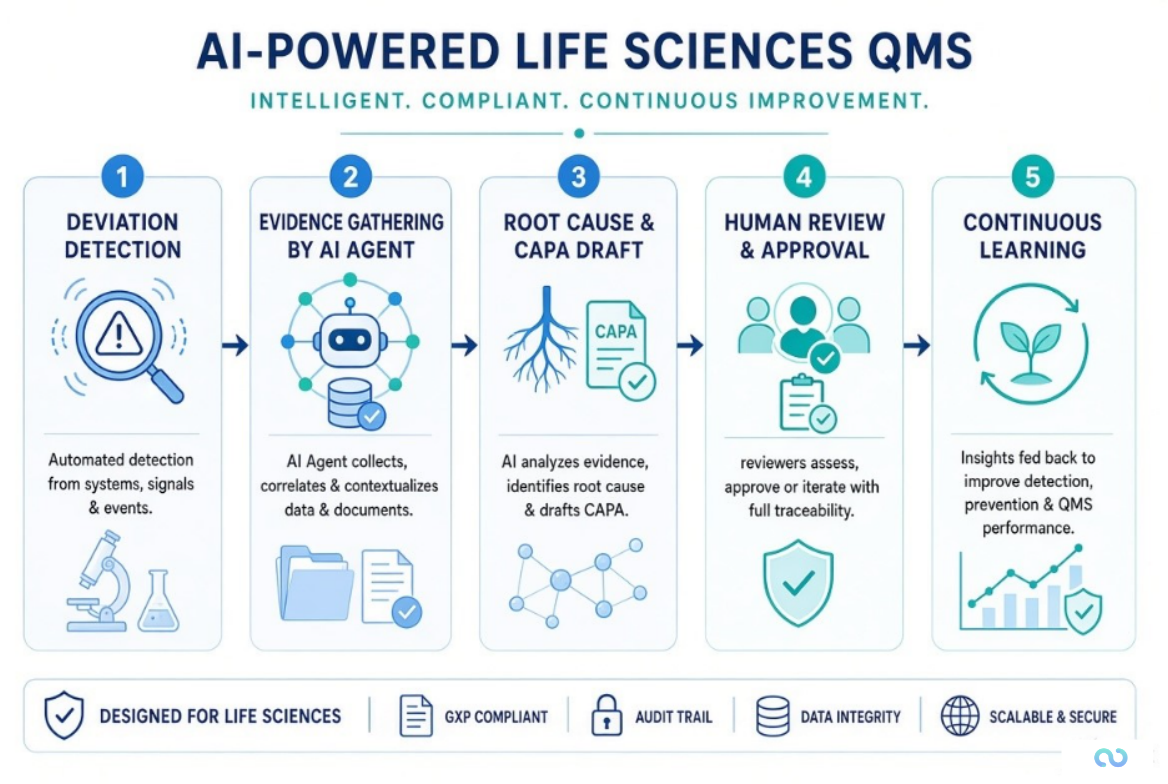
These capabilities extend the value of Quality Management Systems by making them more responsive and insight-driven while preserving the controls required in regulated environments.
Key Benefits for Life Sciences Organizations
| Area | Typical Impact |
|---|---|
| Investigation cycle time | Faster data assembly and structured drafting |
| Consistency | More uniform investigation quality and documentation |
| Audit readiness | Better evidence packaging and trend visibility |
| Resource focus | Quality teams spend more time on judgment and risk |
| Proactive quality | Earlier detection of patterns and systemic issues |
Organizations that embed AI Agents thoughtfully into Quality Management Systems report improved operational efficiency and stronger compliance posture. The same intelligence layer that supports quality processes also connects to broader life sciences innovation. Advances in AI-powered clinical trial operations, for example, share many of the same requirements for data integrity, traceability, and human oversight.
Implementation Considerations and Governance
Successful adoption of AI Agents in Quality Management Systems depends on several factors:
- Clear definition of agent scope, allowed actions, and escalation points
- Secure integration with existing QMS, MES, LIMS, and document systems
- Human-in-the-loop design for all critical decisions
- Robust audit trails and model governance
- Alignment with validation and regulatory expectations
Building these capabilities draws on specialized expertise. AI Agent Development focuses on creating goal-driven systems that can retrieve data, reason, and act within defined boundaries. Generative AI Development supports the creation of structured narratives, investigation summaries, and compliant documentation. Machine Learning Development enables pattern detection, risk scoring, and continuous improvement of predictive signals.
Quality transformation in life sciences does not occur in isolation. Parallel progress in areas such as AI in drug discovery and the use of AI Agents for clinical trial management demonstrates how intelligent systems are being applied across the value chain always with appropriate controls and human accountability.
Starting with high-volume, well-defined processes (deviation triage or CAPA drafting) allows teams to demonstrate value, refine governance, and expand with confidence.
Frequently Asked Questions
1. How do AI Agents improve Quality Management Systems in life sciences?
AI Agents accelerate data gathering, correlate records across systems, draft investigation and CAPA narratives, and support triage while human experts retain final decision authority and accountability.
2. What QMS processes benefit most from AI Agents?
Deviation management, root cause analysis, CAPA documentation, complaint handling, audit preparation, and change impact assessment are among the highest-value starting points.
3. Do AI Agents replace quality professionals?
No. They handle routine data assembly and drafting so quality teams can focus on risk evaluation, scientific judgment, and strategic oversight.
4. How is governance maintained when using AI Agents in regulated environments?
Through clear scope definition, human-in-the-loop approval gates, full audit trails, model governance, and alignment with validation and regulatory expectations.
5. What results can organizations expect?
Common outcomes include faster investigation cycle times, more consistent documentation, improved audit readiness, and better use of quality team capacity.
6. How do AI Agents connect to broader life sciences AI initiatives?
The same principles of data integrity, traceability, and human oversight that apply to Quality Management Systems also support applications in clinical operations and research.
Conclusion
Agentic AI is transforming Quality Management Systems in life sciences by shifting the balance from manual data gathering and reactive responses toward faster, more consistent, and insight-driven quality processes. AI Agents handle evidence assembly, correlation, and first-draft preparation while human experts retain decision authority and scientific oversight.
The result is shorter investigation cycles, stronger audit readiness, and quality teams that can focus on the work that truly requires judgment. Organizations that approach implementation with clear governance, validated integrations, and a focus on high-impact use cases position themselves to improve both compliance and operational performance.
Gleecus TechLabs Inc. partners with life sciences organizations to design and deploy AI Agents that strengthen Quality Management Systems while meeting the rigorous requirements of regulated environments. Whether the priority is deviation management, CAPA acceleration, or broader quality intelligence, we help turn advanced AI into practical, compliant outcomes.