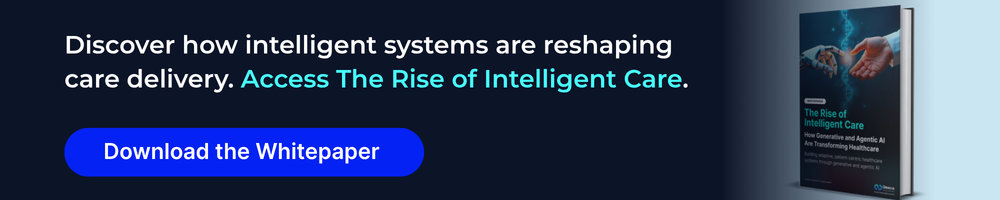
Clinical Decision Support has long been a cornerstone of modern healthcare. Traditional systems deliver alerts, order sets, and guideline reminders inside the electronic health record to help clinicians make safer, more consistent decisions. While valuable, these tools often struggle with alert fatigue, limited context, and the inability to reason across complex, multi-step clinical scenarios.
AI Agents represent a significant evolution. Unlike static rule-based systems, AI Agents can perceive clinical data, reason over goals, use tools, maintain memory, and coordinate multi-step workflows always under human oversight. This shift is transforming Clinical Decision Support in healthcare by making it more contextual, continuous, and actionable.
The Limitations of Traditional Clinical Decision Support
Traditional Clinical Decision Support systems typically rely on predefined rules, knowledge bases, and trigger-based alerts. Common challenges include:
- High volumes of alerts that contribute to alert fatigue
- Limited ability to synthesize information across structured and unstructured data sources
- Difficulty handling multi-step or evolving clinical situations
- Recommendations that lack full patient context or longitudinal history
- Minimal capacity for proactive or adaptive support
As clinical complexity grows and data volumes increase, these limitations become more pronounced. Clinicians need decision support that can assemble relevant evidence, apply guidelines intelligently, and present reasoned options rather than isolated alerts.
What AI Agents Bring to Clinical Decision Support
AI Agents are goal-directed systems capable of multi-step reasoning, tool use, and memory. In a Clinical Decision Support context, they can:
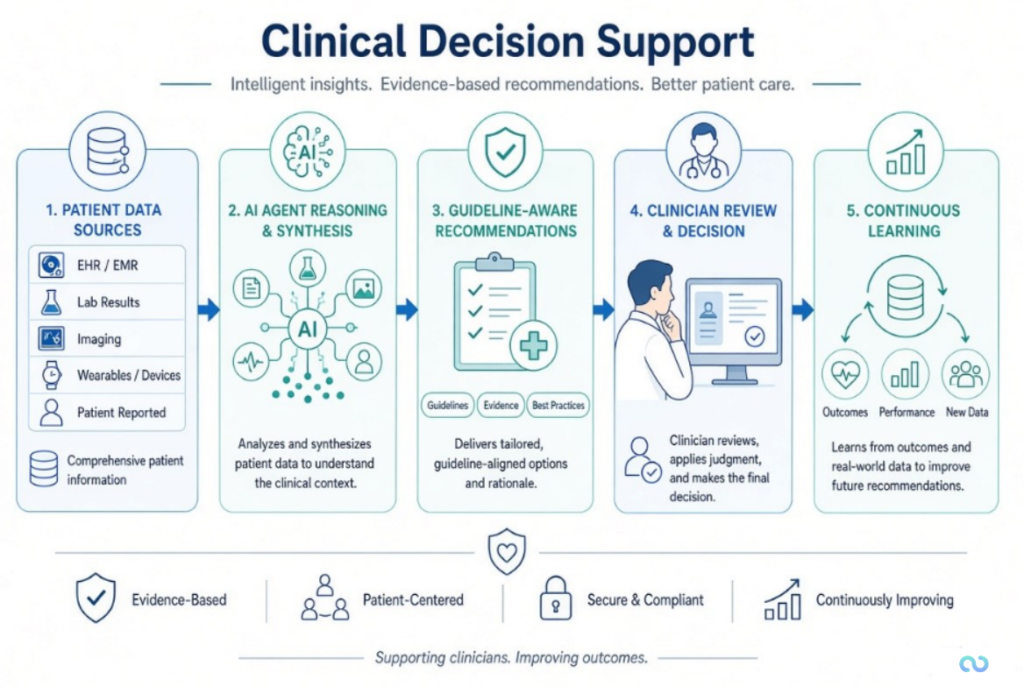
- Retrieve and synthesize patient data from EHR, labs, imaging, and notes
- Apply clinical guidelines and evidence in context
- Generate differential considerations or treatment options with supporting rationale
- Coordinate specialized agents for complex or multidisciplinary cases
- Escalate appropriately and maintain full auditability
Importantly, AI Agents augment rather than replace clinical judgment. Final decisions remain with the clinician. The value lies in reducing cognitive load, improving information completeness, and supporting more consistent application of evidence.
Understanding the broader shift toward intelligent, agentic systems in healthcare is essential for organizations planning next-generation Clinical Decision Support. For a strategic view of how intelligent care models are evolving, explore our whitepaper on the rise of intelligent care.
How AI Agents Enhance Core Clinical Decision Support Capabilities
Multi-Source Data Synthesis and Context
AI Agents can pull together laboratory results, imaging findings, medication history, clinical notes, and prior encounters into a coherent patient picture. This reduces the time clinicians spend searching across systems and helps surface relevant patterns that might otherwise be missed.
Guideline-Aware Reasoning and Recommendations
Rather than simply displaying a guideline link, AI Agents can apply guideline logic to the specific patient context, highlight applicable recommendations, note contraindications, and present options with supporting evidence. This makes Clinical Decision Support more actionable at the point of care.
Multi-Agent Collaboration for Complex Cases
In complex scenarios, specialized agents can collaborate one focused on diagnostics, another on medication safety, another on guideline retrieval while a coordinating agent synthesizes the outputs for clinician review. This multi-agent approach supports higher-quality reasoning for difficult cases.
These capabilities extend the reach of Clinical Decision Support beyond simple alerts into continuous, context-aware assistance across the care continuum.
Key Benefits for Clinicians and Healthcare Organizations
| Benefit Area | Impact on Clinical Decision Support |
|---|---|
| Information completeness | Faster synthesis of multi-source patient data |
| Decision quality | More contextual, evidence-aligned recommendations |
| Cognitive load | Reduced time spent searching and assembling information |
| Consistency | More uniform application of guidelines and best practices |
| Continuity | Support that spans encounters and data sources |
| Scalability | Decision support that scales with growing data complexity |
Healthcare organizations that thoughtfully deploy AI Agents for Clinical Decision Support report improved clinician experience and stronger alignment with evidence-based care. The same agentic capabilities that enhance decision support also connect to operational challenges such as reducing healthcare claim denials through intelligent retrieval and validation, and improving medical coding and claims processing accuracy.
Implementation Considerations and Governance
Successful adoption of AI Agents in Clinical Decision Support requires careful attention to:
- Clear definition of agent scope, allowed actions, and escalation rules
- Secure integration with EHR and clinical data sources
- Human-in-the-loop design for all clinical recommendations
- Robust audit trails, explainability, and model governance
- Alignment with clinical workflows and regulatory expectations
Building these systems draws on specialized capabilities. AI Agent Development focuses on creating goal-driven agents that can reason, use tools, and coordinate within clinical workflows. Generative AI Development supports the creation of clear, contextual summaries and recommendation narratives. Machine Learning Development enables predictive risk scoring, pattern detection, and continuous refinement of decision support models.
Clinical Decision Support does not operate in isolation. Parallel advances in AI for hospital operations and resource management demonstrate how intelligent systems can improve both clinical and operational outcomes when designed with appropriate safeguards.
Starting with well-defined, high-value use cases such as medication safety checks, guideline application for common conditions, or multi-source patient summarization allows teams to demonstrate value, refine governance, and expand responsibly.
Frequently Asked Questions
1. How do AI Agents improve Clinical Decision Support in healthcare?
AI Agents synthesize multi-source patient data, apply guidelines in context, generate reasoned recommendations, and support multi-step clinical workflows while clinicians retain final decision authority.
2. How are AI Agents different from traditional Clinical Decision Support systems?
Traditional systems rely on predefined rules and alerts. AI Agents can reason across data sources, use tools, maintain context, and coordinate multi-step support under human oversight.
3. Do AI Agents replace clinicians in decision-making?
No. They augment clinical judgment by assembling evidence and presenting options. Final decisions remain with the clinician.
4. What clinical areas benefit most from AI Agent supported decision support?
Medication safety, guideline application, complex case synthesis, differential consideration, and multi-disciplinary reasoning are among the highest-value starting points.
5. What governance is required for AI Agents in Clinical Decision Support?
Clear scope definition, human-in-the-loop controls, audit trails, explainability, secure data integration, and alignment with clinical and regulatory expectations.
6. How do AI Agents connect to broader healthcare AI initiatives?
The same principles of context, reasoning, and human oversight that improve Clinical Decision Support also support operational areas such as claims processing and hospital resource management.
Conclusion
AI Agents are transforming Clinical Decision Support in healthcare by moving beyond static alerts and rule-based reminders toward systems that can synthesize context, apply evidence intelligently, and support multi-step clinical reasoning. When designed with strong governance and human oversight, these agents reduce cognitive burden, improve decision consistency, and help clinicians deliver more informed care.
The future of Clinical Decision Support lies in intelligent partners that assemble relevant information, surface reasoned options, and free clinicians to focus on the judgment and empathy that define high-quality care.
Gleecus TechLabs Inc. partners with healthcare organizations to design and deploy AI Agents that strengthen Clinical Decision Support while meeting the rigorous requirements of clinical environments. Whether the priority is contextual patient synthesis, guideline-aware recommendations, or multi-agent collaboration for complex cases, we help turn advanced AI into practical, clinician-centered outcomes.