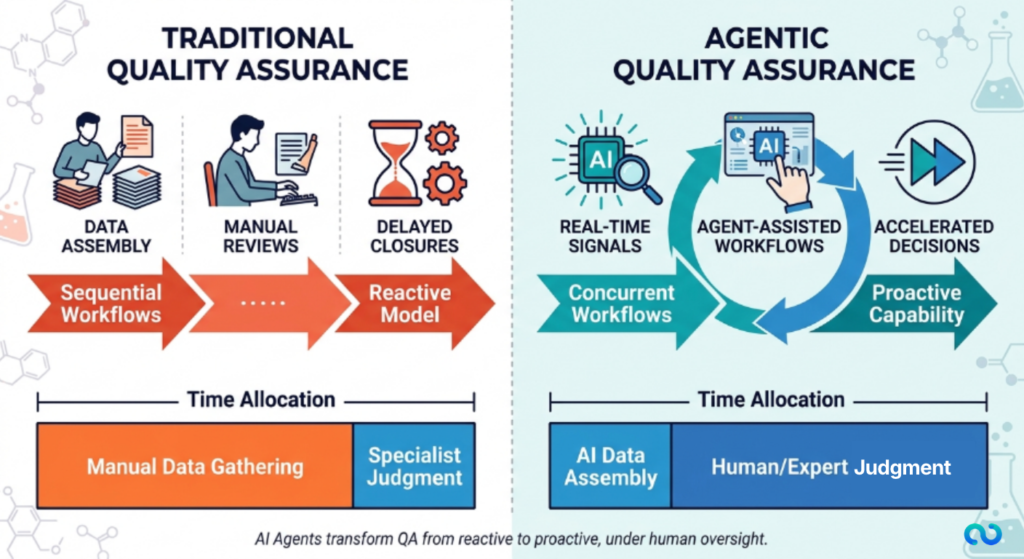
Quality Assurance sits at the center of pharmaceutical manufacturing. Every batch released, every deviation investigated, and every CAPA closed carries direct implications for patient safety, regulatory compliance, and operational efficiency. Traditional Quality Assurance processes, while rigorous, often rely on manual data gathering, sequential reviews, and reactive investigation models that create delays and consume significant specialist time.
Agentic AI is reshaping this landscape. AI Agents can monitor signals across manufacturing and quality systems, retrieve relevant records, reason through multi-step quality workflows, and prepare structured evidence packages all under human oversight. This shift is transforming Quality Assurance in pharmaceutical manufacturing from a largely reactive function into a more proactive, efficient, and consistent capability.
The Challenges of Traditional Quality Assurance in Pharmaceutical Manufacturing
Pharmaceutical Quality Assurance teams face persistent operational pressures:
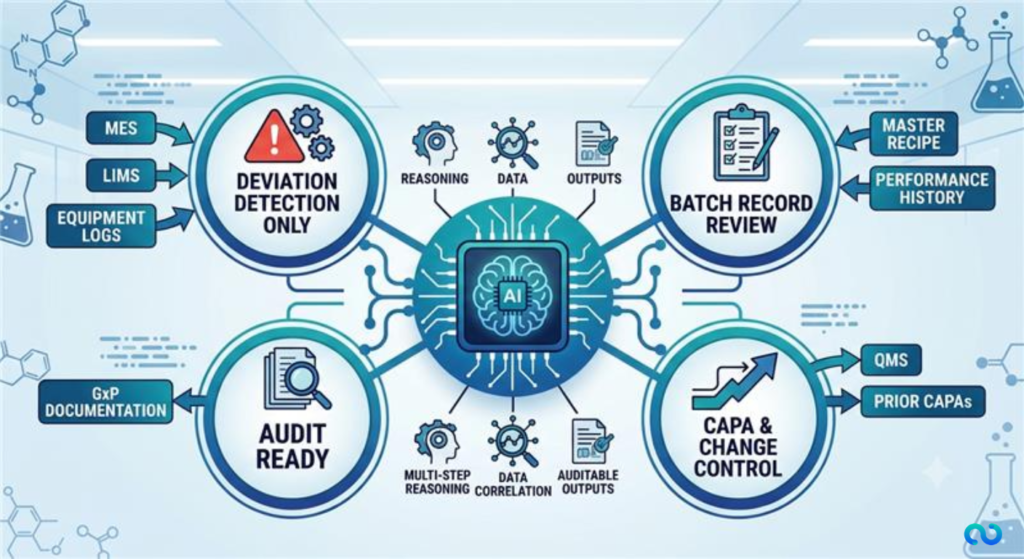
- Deviation investigations that require pulling data from MES, LIMS, equipment logs, environmental monitoring, and historical records
- Batch record reviews that demand detailed cross-checking against specifications and process parameters
- CAPA development and effectiveness checks that depend on thorough root cause analysis
- Change control assessments that must evaluate multi-system impact
- Audit and inspection readiness that relies on complete, traceable documentation
These activities are essential, yet the time spent assembling evidence and drafting narratives often exceeds the time spent on scientific judgment. Inconsistent documentation quality and delayed closures further increase regulatory and operational risk.
What Agentic AI Brings to Quality Assurance
Agentic AI systems differ from simple rule-based alerts or generative drafting tools. They can pursue defined quality goals, use multiple tools and data sources, maintain context across steps, and produce auditable outputs while escalating decisions that require human authority.
In pharmaceutical Quality Assurance, AI Agents can:
- Detect or receive quality signals in near real time
- Automatically retrieve and correlate batch records, process data, equipment history, and prior similar events
- Classify events, rank likely contributing factors, and assemble evidence packages
- Draft structured investigation narratives and CAPA recommendations aligned with internal templates
- Support continuous monitoring for emerging trends
Human quality professionals retain full decision rights. The agents handle the heavy lifting of data assembly and first-draft preparation so experts can focus on analysis, risk assessment, and final disposition.
Understanding the broader application of AI across the pharmaceutical value chain helps organizations prioritize high-impact Quality Assurance opportunities. For a strategic overview of current adoption patterns, explore our whitepaper on the state of AI in pharma.
How AI Agents Transform Core Quality Assurance Processes
Deviation Detection, Triage, and Investigation
When a deviation or out-of-specification result occurs, AI Agents can rapidly gather contextual data from connected systems, identify related historical events, and prepare an initial investigation package. This compresses the data-assembly phase that traditionally consumes the majority of investigation time and enables faster, more consistent triage.
Batch Record Review and Exception Management
AI Agents can scan batch records against master recipes, process validation ranges, and historical performance. They highlight true exceptions rather than every numerical variance, allowing reviewers to focus on material issues. Machine Learning Development supports the pattern recognition and anomaly detection that make these reviews more precise.
CAPA, Change Control, and Audit Readiness
Agents assist in root cause exploration by correlating process parameters, equipment status, and prior CAPAs. They can draft CAPA language and impact assessments for change controls, while maintaining complete audit trails. Generative AI Development enables clear, structured drafting of investigation narratives and controlled documents that accelerate review cycles.
These capabilities allow Quality Assurance teams to move from sequential, labor-intensive processes toward continuous, intelligence-supported workflows.
Key Benefits for Pharmaceutical Manufacturers
| Benefit Area | Impact on Quality Assurance in Pharmaceutical Manufacturing |
|---|---|
| Investigation cycle time | Faster evidence assembly and structured drafting |
| Consistency | More uniform investigation quality and documentation |
| Reviewer productivity | Reduced time spent searching systems and compiling data |
| Audit readiness | Better packaged evidence and trend visibility |
| Proactive quality | Earlier detection of patterns and systemic risks |
| Resource focus | Quality experts spend more time on judgment and risk |
Organizations that embed AI Agents into Quality Assurance report meaningful reductions in cycle times, particularly in the data-gathering phase of deviations and batch reviews, while strengthening the consistency and defensibility of quality decisions.
Implementation Considerations and Governance
Successful adoption of Agentic AI in pharmaceutical Quality Assurance depends on disciplined design:
- Clear definition of agent scope, decision rights, and escalation thresholds
- Secure, validated integration with MES, LIMS, QMS, and related systems
- Human-in-the-loop controls for all quality dispositions and CAPA approvals
- Full audit trails, version control, and explainability aligned with GxP expectations
- Change control and validation strategies appropriate for regulated environments
Building these systems requires specialized capabilities. AI Agent Development focuses on creating goal-directed agents that can orchestrate multi-step quality workflows while respecting regulatory guardrails. Starting with well-defined, high-volume processes such as deviation data assembly or batch record exception flagging allow teams to demonstrate value, refine governance, and expand with confidence.
Quality Assurance transformation does not occur in isolation. Parallel advances in manufacturing execution, process monitoring, and overall quality system design show how intelligent agents can support both operational efficiency and stronger compliance posture when implemented with appropriate human accountability.
Frequently Asked Questions
1. How do AI Agents improve Quality Assurance in pharmaceutical manufacturing?
AI Agents retrieve and correlate data across systems, prepare structured evidence packages, support root cause analysis, and draft investigation narratives while quality professionals retain final decision authority.
2. What Quality Assurance processes benefit most from Agentic AI?
Deviation investigation and triage, batch record review, CAPA development, change control impact assessment, and audit preparation are among the highest-value starting points.
3. Do AI Agents replace Quality Assurance professionals?
No. They handle data assembly, pattern detection, and first-draft preparation so experts can focus on judgment, risk assessment, and disposition decisions.
4. How does Agentic AI differ from traditional quality automation?
Traditional automation follows fixed rules. Agentic AI can pursue quality goals, adapt to context, coordinate multi-step workflows, and produce auditable recommendations under human oversight.
5. What governance is required for AI Agents in pharmaceutical Quality Assurance?
Clear scope and escalation rules, validated system integration, human-in-the-loop controls for dispositions, comprehensive audit trails, and alignment with GxP and data integrity expectations.
6. Can AI Agents support audit and inspection readiness?
Yes. By maintaining complete evidence trails, consistent documentation, and faster packaging of supporting records, AI Agents help quality teams respond more effectively to audits and inspections.
Conclusion
Agentic AI is transforming Quality Assurance in pharmaceutical manufacturing by enabling systems that can gather evidence, reason across data sources, and prepare structured recommendations under continuous human oversight. AI Agents handle the repetitive and time-consuming elements of investigations, reviews, and documentation so that quality professionals can concentrate on scientific judgment, risk evaluation, and final decisions.
The result is faster cycle times, more consistent documentation, improved audit readiness, and a Quality Assurance function better positioned to support both patient safety and operational performance.
Gleecus TechLabs Inc. partners with pharmaceutical manufacturers to design and deploy AI Agents that strengthen Quality Assurance while meeting the rigorous requirements of regulated environments. Whether the priority is accelerating deviation investigations, improving batch record review, or enhancing CAPA and change control processes, we help turn advanced AI into practical, compliant outcomes.