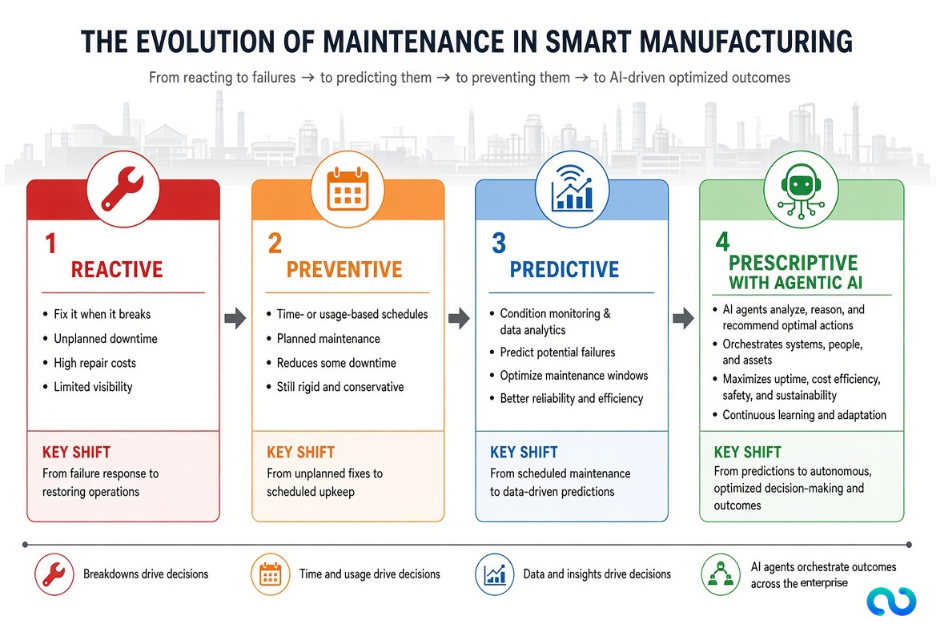
Manufacturers have long sought ways to reduce unplanned downtime and improve asset reliability. Predictive maintenance marked a major step forward by forecasting potential failures using sensor data and analytics. Yet prediction alone is not enough. The next frontier is prescriptive maintenance, determining not only what might fail, but what action should be taken, when, and how. Agentic AI is now enabling this shift within Smart Manufacturing environments.
At Gleecus TechLabs Inc., we help manufacturers apply intelligent systems that move operations from insight to coordinated action. This article explores how Agentic AI is advancing maintenance from predictive to prescriptive in Smart Manufacturing.
The Limits of Prediction Alone
Predictive maintenance uses sensor data, historical patterns, and analytical models to forecast potential failures. It answers an important question: What might go wrong, and roughly when?
However, prediction by itself does not complete the job. After an alert appears, teams must still:
- Investigate the likely root cause
- Check spare parts availability
- Identify qualified technicians
- Align the intervention with production schedules
- Create and assign work orders
These steps often involve multiple systems and manual handoffs, introducing delays that erode the value of early warnings.
What Agentic AI Brings to Smart Manufacturing
Agentic AI systems can perceive operational signals, reason about goals, interact with tools and enterprise systems, and execute multi-step workflows with defined autonomy. In Smart Manufacturing, these agents can connect predictive outputs with maintenance histories, inventory data, workforce schedules, and production calendars.
Instead of stopping at an alert, Agentic AI helps determine what should be done next, when it should happen, and how it should be coordinated.
How the Shift to Prescriptive Maintenance Works
Prescriptive maintenance builds on prediction by recommending or initiating specific actions. Agentic AI supports this progression through structured workflows:
- Detect – Continuous monitoring identifies anomalies or predicted degradation.
- Diagnose – Agents review equipment history, documentation, and similar asset patterns.
- Evaluate – Availability of parts, skilled personnel, and production windows is assessed.
- Prescribe – Prioritized recommendations or work orders are generated with supporting context.
- Act or Escalate – Actions proceed automatically for routine cases or are routed for human approval when risk or complexity is higher.
This approach compresses the time between insight and intervention while retaining appropriate oversight.
Key Benefits for Smart Manufacturing Operations
When Agentic AI supports prescriptive maintenance, manufacturers can achieve:
- Faster response cycles – Reduced lag between prediction and coordinated action
- Lower unplanned downtime – Earlier, better-supported interventions
- More efficient resource use – Improved alignment of parts, labor, and production plans
- Higher-quality decisions – Recommendations informed by broader operational context
- Greater scalability – Ability to manage more assets without proportional increases in manual coordination
| Aspect | Predictive Maintenance | Prescriptive with Agentic AI |
|---|---|---|
| Core output | Failure forecasts | Actionable recommendations or coordinated steps |
| Coordination | Mostly manual | Automated or semi-automated |
| Context used | Sensor and model data | History, inventory, schedules, constraints |
| Time to intervention | Dependent on human follow-up | Significantly reduced |
| Scalability | Limited by staff capacity | More readily extended across the plant |
Practical Considerations for Adoption
Successful deployment depends on several foundations:
- Reliable sensor coverage and clean operational data
- Integration with maintenance, inventory, and production systems
- Clear governance defining autonomy levels and approval requirements
- Strong observability so decisions remain transparent and auditable
- Collaboration between maintenance, operations, and technology teams
- A phased rollout that begins with high-impact assets
Organizations that treat Agentic AI as part of a broader operational system rather than an isolated tool, see stronger and more sustainable results.
Looking Ahead
The move from predictive to prescriptive maintenance marks an important evolution for Smart Manufacturing. Agentic AI provides the reasoning and coordination layer that turns forecasts into timely, context-aware action. Manufacturers that invest in the necessary data foundations, system connections, and governance frameworks will be better positioned to improve reliability, reduce operational friction, and sustain competitive performance.