The modern retail experience spans multiple channels, touchpoints, and moments of decision. Customers expect seamless discovery, personalized recommendations, frictionless purchasing, and responsive post-purchase support. AI Agents are emerging as a powerful way to connect these moments into a coherent, end-to-end experience. By observing signals, reasoning about intent, and taking coordinated action, AI Agents can orchestrate the Retail Customer Journey with greater speed, relevance, and consistency.
At Gleecus TechLabs Inc., we help organizations design intelligent systems that improve customer engagement and operational efficiency. This article explores how AI Agents can orchestrate the end-to-end Retail Customer Journey.
Understanding AI Agents in Retail
AI Agents are autonomous or semi-autonomous systems capable of pursuing goals through planning, tool use, and multi-step reasoning. In retail, they operate within the context of product catalogs, inventory, customer data, loyalty programs, and channel systems.
Unlike traditional chatbots that respond to individual queries, AI Agents can interpret intent, coordinate across systems, and execute actions, such as recommending products, recovering carts, resolving issues, or triggering follow-up communications, while remaining aligned with defined business rules and customer preferences.
Challenges in the Traditional Retail Customer Journey
Traditional approaches often struggle with fragmentation:
- Disconnected experiences across web, mobile, store, and support channels
- Generic recommendations that fail to reflect real-time context
- High friction in discovery, checkout, and returns
- Limited ability to act proactively on customer signals
- Manual handoffs that slow resolution and reduce consistency
These gaps can lead to abandoned journeys, lower conversion, and weaker long-term loyalty.
How AI Agents Orchestrate the Customer Journey
AI Agents address these challenges by creating a continuous loop of observation, decision, and action:
- Observe: Capture signals such as browsing behavior, search intent, inventory status, and prior interactions.
- Decide: Reason about the next best action based on customer context and business objectives.
- Act: Execute coordinated steps across systems—recommendations, messaging, order updates, or support workflows.
- Learn: Incorporate outcomes to refine future responses.
This orchestration enables a more fluid and personalized Retail Customer Journey.
Move from experimentation to orchestration.
Retail leaders who treat AI as a collection of isolated tools will fall behind those who redesign the customer journey around intelligent agents.
Our whitepaper, Reimagining Retail Through Agentic and Generative Intelligence, delivers a clear framework for embedding agentic capabilities across discovery, conversion, support, and loyalty.

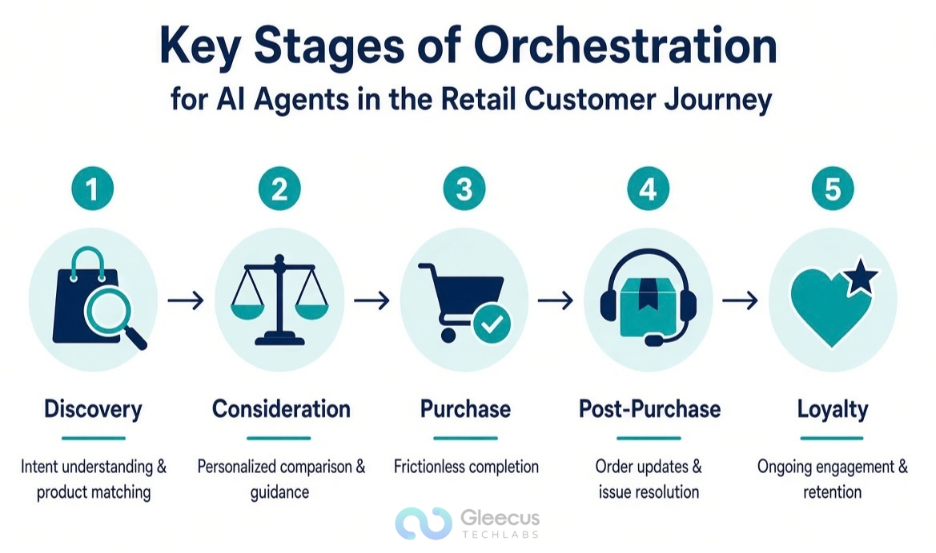
Key Stages of Orchestration
AI Agents can support customers across the full journey:
Discovery and Exploration
Agents interpret natural-language intent, filter products by attributes and availability, and surface personalized options.
Consideration and Decision
They compare alternatives, highlight relevant details, and assist with sizing, compatibility, or substitutions.
Purchase and Checkout
Agents help reduce friction by guiding customers through options, confirming availability, and supporting streamlined completion.
Post-Purchase and Support
They manage order updates, handle returns or exchanges, and resolve common inquiries with full context.
Loyalty and Retention
Agents personalize ongoing engagement, recommend relevant offers, and support long-term relationship building.
| Journey Stage | Role of AI Agents | Example Outcomes |
|---|---|---|
| Discovery | Intent understanding and product matching | Faster relevant results |
| Consideration | Comparison and personalization | Higher confidence and conversion |
| Purchase | Friction reduction and guidance | Improved completion rates |
| Post-Purchase | Issue resolution and updates | Faster support and higher satisfaction |
| Loyalty | Ongoing relevance and engagement | Stronger retention |

Benefits for Retailers
When effectively deployed, AI Agents deliver several advantages for the Retail Customer Journey:
- Greater Consistency: Customers experience coherent interactions across channels.
- Higher Relevance: Recommendations and actions reflect real-time context and preferences.
- Faster Resolution: Routine inquiries and processes are handled more efficiently.
- Improved Conversion: Reduced friction and better guidance support purchase completion.
- Scalable Personalization: Individualized experiences become feasible at volume.
Implementation Considerations
Successful orchestration requires careful design:
- Strong data foundations connecting customer, product, inventory, and interaction signals
- Clear governance defining autonomy levels and human oversight
- Integration with existing commerce, CRM, and support systems
- Continuous evaluation of accuracy, relevance, and customer outcomes
- Alignment between technology, marketing, operations, and service teams
A phased approach, starting with high-impact journey stages, helps build confidence and demonstrate value.

Looking Ahead
AI Agents are shifting the Retail Customer Journey from a series of disconnected interactions into a coordinated, intelligent experience. Retailers that invest in thoughtful agent orchestration will be better positioned to meet rising customer expectations, improve operational efficiency, and build lasting relationships. The opportunity lies not only in automation, but in creating journeys that feel responsive, relevant, and continuous.