Healthcare organizations face a persistent operational paradox. Demand for care continues to rise, yet a substantial share of clinician and staff time is consumed by administrative work rather than direct patient interaction. Scheduling, prior authorization, claims processing, documentation, eligibility verification, and compliance reporting create significant friction across healthcare operations.
Traditional automation and rule-based tools have delivered incremental gains, but they often remain limited to discrete tasks and require constant human initiation. Agentic AI represents a meaningful shift. AI Agents can plan multi-step workflows, adapt to changing conditions, coordinate across systems, and execute within defined guardrails transforming healthcare operations and administrative workflows from reactive and labor-intensive into more proactive and efficient processes.
The Administrative Burden in Modern Healthcare Operations
Administrative workflows form the backbone of healthcare delivery, yet they frequently create bottlenecks:
- Prior authorization processes that delay care and consume staff hours
- Claims submission, denial management, and follow-up that require repeated data assembly
- Patient intake and scheduling that involve multiple systems and manual verification
- Documentation and coding tasks that pull clinicians away from patients
- Resource coordination challenges such as bed management and staffing alignment
These activities are essential for revenue integrity, regulatory compliance, and patient access. When handled manually or through fragmented tools, they increase costs, slow throughput, and contribute to staff burnout. Healthcare operations teams need systems that can handle volume, maintain accuracy, and escalate appropriately when human judgment is required.
What Agentic AI Brings to Healthcare Operations
Agentic AI systems go beyond responding to prompts or executing fixed rules. They can perceive information from multiple sources, reason toward goals, use tools across platforms, maintain context, and take sequenced actions while remaining accountable to human oversight.
In healthcare operations, AI Agents can:
- Assemble clinical and administrative data from EHR, payer portals, and internal systems
- Complete multi-step processes such as eligibility checks, authorization packages, or claim preparation
- Monitor status, detect exceptions, and initiate follow-up actions
- Generate clear summaries and documentation for human review
- Coordinate specialized agents for complex administrative journeys
The result is a shift from staff executing every step to staff supervising intelligent workflows and intervening on exceptions. This model preserves clinical and operational accountability while significantly reducing repetitive effort.
Understanding the broader evolution of intelligent systems in care delivery provides valuable context for operational transformation. For a strategic perspective on how intelligent care models are advancing, explore our whitepaper on the rise of intelligent care.
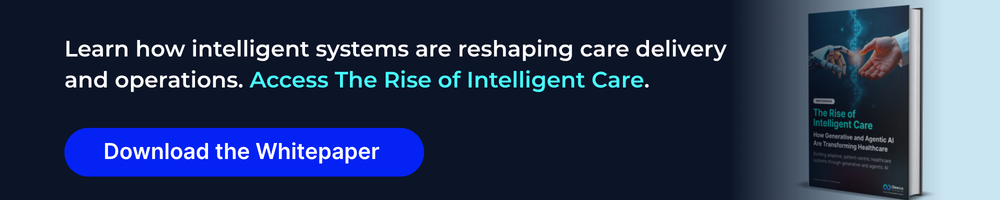
How AI Agents Transform Core Administrative Workflows
Patient Intake, Scheduling, and Eligibility
AI Agents can process intake forms, verify insurance eligibility, create or update patient records, propose available appointment slots, and send confirmations or pre-visit instructions. By handling these steps end-to-end within approved boundaries, agents reduce front-desk workload and improve patient experience from the first interaction.
Prior Authorization and Revenue Cycle Tasks
One of the highest-friction areas in healthcare operations is prior authorization and claims-related work. AI Agents can retrieve relevant clinical documentation, match it against payer criteria, assemble and submit requests, track status, and prepare responses for denials escalating only when clinical judgment is required. The same capabilities that support accurate coding and claims processing also strengthen overall revenue cycle performance.
Documentation, Compliance, and Resource Coordination
Agents can draft structured notes from encounters, flag missing elements for compliance, support audit preparation, and assist with operational coordination such as bed availability or discharge readiness. Machine Learning Development enables predictive insights that help agents anticipate bottlenecks and prioritize actions.
These transformations allow healthcare operations teams to move from reactive firefighting to continuous, intelligent support across administrative workflows.
Key Benefits for Healthcare Organizations
| Benefit Area | Impact on Healthcare Operations and Administrative Workflows |
|---|---|
| Staff productivity | Reduced time spent on repetitive data gathering and follow-up |
| Cycle time | Faster completion of authorizations, claims, and intake processes |
| Revenue integrity | Fewer avoidable denials and improved documentation completeness |
| Clinician experience | More time available for patient care and complex decision-making |
| Scalability | Ability to handle volume growth without proportional headcount increases |
| Consistency | More uniform application of policies and fewer process variations |
Organizations that deploy Agentic AI thoughtfully report meaningful reductions in administrative burden and improvements in both operational metrics and staff satisfaction. The intelligence that improves prior authorization and claims handling also connects to broader efforts aimed at reducing healthcare claim denials through smarter retrieval and validation.
Implementation Considerations and Governance
Successful adoption of Agentic AI in healthcare operations requires careful design:
- Clear definition of agent scope, allowed actions, and escalation rules
- Secure integration with EHR, revenue cycle, scheduling, and payer systems
- Human-in-the-loop controls for any decision with clinical or financial impact
- Full audit trails, explainability, and compliance with privacy regulations
- Change management that repositions staff toward oversight and exception handling
Building these capabilities draws on specialized expertise. AI Agent Development focuses on creating goal-directed agents that can orchestrate multi-step administrative workflows. Generative AI Development supports the creation of clear summaries, status updates, and documentation drafts that keep teams informed.
Healthcare operations transformation benefits from a holistic view. Parallel advances in hospital operations and resource management demonstrate how intelligent systems can improve capacity utilization, staffing alignment, and patient flow when designed with appropriate safeguards.
Starting with high-volume, rules-heavy processes such as eligibility verification, prior authorization packaging, or routine claims preparation allow organizations to demonstrate value, refine governance, and expand responsibly.
Frequently Asked Questions
1. How does Agentic AI improve healthcare operations and administrative workflows?
Agentic AI enables systems that can plan multi-step processes, gather data across systems, execute routine tasks, monitor status, and escalate exceptions, reducing manual effort while keeping humans in control of key decisions.
2. What administrative areas benefit most from AI Agents?
Patient intake and scheduling, prior authorization, claims preparation and denial management, documentation support, eligibility verification, and operational resource coordination are among the highest-value starting points.
3. Do AI Agents replace administrative staff in healthcare?
No. They handle repetitive coordination and data assembly so staff can focus on exceptions, complex cases, oversight, and higher-value interactions.
4. How does Agentic AI differ from traditional healthcare automation?
Traditional automation follows fixed rules for discrete tasks. Agentic AI can reason toward goals, adapt to changing conditions, coordinate across multiple systems, and manage multi-step workflows with human oversight.
5. What governance is required for AI Agents in healthcare operations?
Clear scope and decision rights, secure system integration, human-in-the-loop controls for impactful actions, comprehensive audit trails, privacy compliance, and ongoing performance monitoring.
6. How do AI Agents support revenue cycle performance?
By improving documentation completeness, accelerating prior authorization, detecting potential claim issues early, and supporting consistent coding and submission processes all under appropriate human review.
Conclusion
Agentic AI is transforming healthcare operations and administrative workflows by enabling systems that can plan, execute, and adapt multi-step processes under human oversight. AI Agents handle routine coordination, data assembly, and status tracking so that clinicians and staff can focus on judgment, complex cases, and patient relationships.
The outcome is more efficient operations, reduced administrative burden, stronger revenue integrity, and a more sustainable working environment for healthcare teams. When implemented with clear governance and a focus on high-impact use cases, Agentic AI becomes a practical partner in delivering both operational excellence and better care experiences.
Gleecus TechLabs Inc. partners with healthcare organizations to design and deploy AI Agents that strengthen operations and administrative workflows while meeting the rigorous requirements of regulated environments. Whether the priority is streamlining prior authorization, improving claims accuracy, or coordinating resource workflows, we help turn advanced AI into measurable operational outcomes.