Choosing the right artificial intelligence approach is no longer a purely technical decision; it is a strategic one. As organizations evaluate Traditional AI vs Agentic AI vs Agentic RAG, the goal is to match capabilities with real business requirements rather than adopt the newest technology for its own sake. Each paradigm offers distinct strengths, limitations, and ideal use cases.
At Gleecus TechLabs Inc., we help enterprises navigate this decision with clarity. This article breaks down Traditional AI vs Agentic AI vs Agentic RAG and provides practical guidance on selecting the approach that best fits your operational needs.
Understanding the Three Approaches
Traditional AI
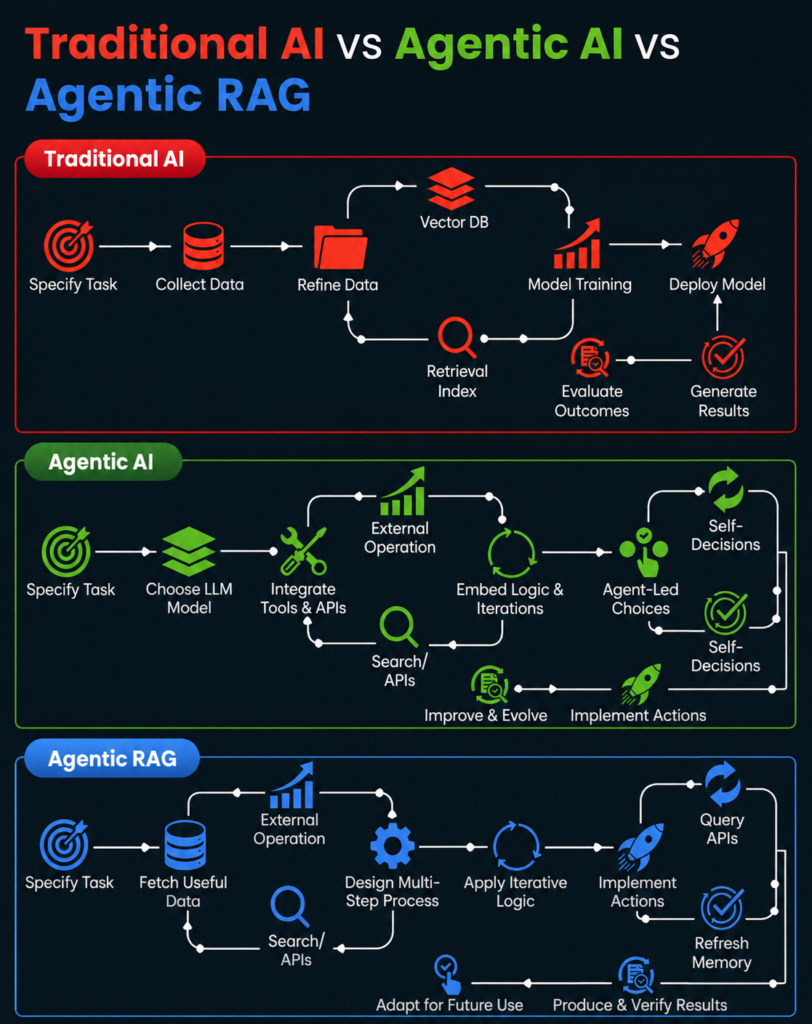
Traditional AI centers on building models for specific, well-defined tasks. It follows a structured pipeline of data collection, preprocessing, training, evaluation, and deployment. Once live, these systems typically remain static and require manual intervention for updates or retraining. Traditional AI performs reliably for prediction, classification, and pattern recognition when the problem space is stable.
Agentic AI
Agentic AI introduces autonomy. Instead of delivering a single output, agents can plan multi-step processes, reason about intermediate results, interact with tools and APIs, and adapt their actions over time. This makes Agentic AI suitable for dynamic workflows that benefit from decision-making and continuous adjustment.
Agentic RAG
Agentic RAG combines retrieval-augmented generation with agentic capabilities. Traditional RAG retrieves relevant information to ground language model responses. Agentic RAG elevates this by allowing autonomous agents to dynamically manage retrieval, refine queries, plan strategies, use external tools, and maintain context across complex, knowledge-intensive tasks.
Key Differences That Matter for Business
| Factor | Traditional AI | Agentic AI | Agentic RAG |
|---|---|---|---|
| Primary Strength | Predictable performance on fixed tasks | Autonomy and multi-step decision-making | Knowledge grounding + adaptive reasoning |
| Adaptability | Low | High | Very high |
| Knowledge Scope | Limited to training data | Expanded via tools and APIs | Dynamically retrieved and refined |
| Complexity Handling | Best for narrow problems | Strong for process automation | Excellent for multi-source, evolving queries |
| Cost & Latency Profile | Generally lower and more predictable | Higher due to iterative reasoning | Highest potential cost and variability |
| Governance Needs | Moderate | High | Highest |
Understanding these differences in Traditional AI vs Agentic AI vs Agentic RAG helps avoid over-engineering simple problems or under-powering complex ones.
Traditional AI vs Agentic AI vs Agentic RAG
When Each Approach Fits Best
Traditional AI is often the right choice when:
- The task is stable and well-defined.
- High predictability and lower operational cost are priorities.
- Historical data patterns remain reliable over time.
- Examples include demand forecasting, fraud detection rules, image classification, or quality inspection.
Agentic AI fits well when:
- Workflows involve multiple sequential or conditional steps.
- Systems need to interact with external tools or applications.
- Adaptability to changing conditions delivers clear value.
- Examples include automated case handling, multi-step process orchestration, or intelligent routing.
Agentic RAG becomes preferable when:
- Accurate, up-to-date knowledge is essential.
- Queries require synthesizing information from multiple sources.
- Complex reasoning must be combined with retrieval.
- Examples include research assistance, dynamic customer support grounded in enterprise knowledge, compliance analysis, or multi-document investigation.
Practical Decision Framework
To decide among Traditional AI vs Agentic AI vs Agentic RAG, evaluate these dimensions:
- Task Stability — How often do requirements or data patterns change?
- Knowledge Dependency — Does the system need current or external information?
- Autonomy Requirement — Should the system plan and act independently?
- Risk Tolerance — How critical are errors, and how easily can they be monitored?
- Resource Constraints — What are acceptable levels of cost, latency, and complexity?
Many organizations successfully use a hybrid strategy. Traditional AI handles high-volume, stable workloads, while Agentic AI or Agentic RAG addresses more dynamic or knowledge-intensive processes.
Benefits and Trade-Offs at a Glance
Traditional AI
- Benefits: Reliability, lower cost, easier explainability
- Trade-offs: Limited flexibility, manual maintenance
Agentic AI
- Benefits: Higher autonomy, better handling of multi-step tasks
- Trade-offs: Increased complexity and need for strong oversight
Agentic RAG
- Benefits: Grounded answers combined with adaptive reasoning
- Trade-offs: Higher latency and cost variability, greater need for evaluation and observability
Making the Choice with Confidence
Selecting the optimal approach from Traditional AI vs Agentic AI vs Agentic RAG starts with a clear understanding of business objectives rather than technology trends. Begin by mapping current pain points, defining success metrics, and assessing data readiness and governance maturity. Pilot focused use cases before scaling, and continuously measure outcomes against defined goals.
Organizations that match the right AI paradigm to the right problem achieve faster returns and lower long-term risk.